What's Best Next

  • Newsletter
  • Our Mission
  • Contact
  • Resources
    • Productivity
    • Leadership
    • Management
    • Web Strategy
    • Book Extras
  • Consulting & Training
  • Store
    • Online Store
    • Cart
    • My Account
  • About
    • Our Mission
    • Our Core Values
    • Our Approach to Productivity
    • Our Team
    • Contact
You are here: Home / Archives for 1 - Productivity

Resources on Productivity

Those Who Set Goals Accomplish More. And: Be Careful to Have the Right Goals

December 16, 2010 by Matt Perman

Stephen Covey notes that:

In the field of personal development, one of the few things that can be empirically validated is that individuals and organizations that set goals accomplish more. The reality is that people who know how to set and achieve goals generally accomplish what they set out to do.

That’s interesting.

But, don’t take it as a whole-sale endorsement on setting goals. Covey goes on to note the weaknesses of this approach:

There are countless people who use the Goal Approach to climb the ladder of success — only to discover it’s been leaning against the wrong wall.

They set goals and focus powerful effort to achieve them. But when they get what they wanted, they find it doesn’t bring the results they expected. Life seems empty, anticlimatctic. “Is that all there is?”

When goals are not based on principles and primary needs, the focused drive and single-mindedness that makes achievement possible can blind people to imbalance in their lives. They may have their six- or seven-figure income, but they’re living with the deep pain of multiple divorces and children who won’t even talk to them. They may have a glamorous public image, but an empty private life. They have the plaudits of the world, but no rich, satisfying relationships, no deep inner sense of integrity.

It is important to have goals. But there is also a danger in having goals. What’s the solution?

One part of the solution is to have the right goals. Another part of the solution is to not let your life be _entirely_ directed by goals.

You see a good example of this in the life of the apostle Paul. He had an overarching goal — a mission — that was right. Here’s one statement of it (there are others as well):

Indeed, I count everything as loss because of the surpassing worth of knowing Christ Jesus my Lord. For his sake I have suffered the loss of all things and count them as rubbish, in order that I may gain Christ and be found in him, not having a righteousness of my own that comes from the law, but that which comes through faith in Christ, the righteousness from God that depends on faith — that I may know him and the power of his resurrection, and may share his sufferings, becoming like him in his death, that by any means possible I may attain the resurrection from the dead. (Philippians 3:8-11).

Forgetting what lies behind and straining forward to what lies ahead, I press on toward the goal for the prize of the upward call of God in Christ Jesus. (Philippians 3:13-14).

Paul’s overarching mission here is an example of a goal, an ultimate goal, that should cover our entire lives and for which we should sacrifice greatly for. And he commends the same goal to each of us: “Let those of us who are mature think this way” (v. 15).

Paul also had some lower-altitude goals that aligned with this. For example, he really desired to visit the church in Rome:

“. . . without ceasing I mention you always in my prayers, asking that somehow by God’s will I may now at last succeed in coming to you.” (Romans 1:9-10)

But this was not an all-defining goal, because other things took precedence and prevented him from coming (see Romans 15:18-24–very interesting: what kept him from coming was another goal). Paul had other goals like this as well — things he really wanted to do, but which he sought to do in an integrated way with all the other callings that God had placed before him.

What we see in Paul is a good example of goals working in the right way. He had the right overall goal, or aim, in life. He pursued that goal at all costs — and, because it was the right goal that God would have for him (and us), that did not result in unloving, unbibiblically unbalanced (note: the term “unbiblical” is a critical nuance there) life.

Then, underneath that, he had many lower-altitude goals that aligned with it, and which he pursued with great diligence, but which he didn’t pursue at all costs and without the wider awareness of other things, apart from those goals, that God might want to do in his life.
Filed Under: Goals

Effectiveness is Not Innate–You Have to Learn it and Practice It

December 15, 2010 by Matt Perman

This is significant, from Drucker in his book The Effective Executive:

[The practices of effectiveness] are not “inborn.” In forty-five years of work as a consultant with a large number of executives in a wide variety of organizations — large and small; businesses, government agencies, labor unions, hospitals, universities, community services; American, European, Latin American and Japanese — I have never come across a single “natural”: an executive who was born effective. [emphasis added]

Did you catch that? Drucker wrote those words toward the latter part of his long career. He had been doing consulting work for forty-five years. He had consulted with executives in all types of organizations — all types. And he had consulted all over the world — all over the world. And he never came across a single natural. Never.

So we probably shouldn’t think of ourselves as naturals, either. And we shouldn’t be too hard on others we know and encounter that aren’t “naturals.”

Instead, we need to realize that if we are to become effective and increase in effectiveness, it comes through learning, effort, and practice. Which is what Drucker goes on to say:

All the effective ones had to learn to be effective. And all of them had to practice effectiveness until it became a habit.

And here is an encouraging word on that:

All the ones who worked on making themselves effective executives succeeded in doing so. Effectiveness can be learned — and it also has to be learned.

Filed Under: a Productivity Philosophy

Making Room for the New Means Getting Rid of the Old

December 10, 2010 by Matt Perman

From David Allen’s latest newsletter (which you can subscribe to here):

It’s time to purge.

The end of a year and start of the new is a great metaphorical event you can use to enhance a critical aspect of your constructive creativity—get rid of everything that you can.

Your psyche has a certain quota of open loops and incompletions that it can tolerate, and it will unconsciously block the engagement with new material if it has reached its limit. Release some memory.

Want more business? Get rid of all the old energy in the business you’ve done. Are there any open loops left with any of your clients? Any agreements or disagreements that have not been completed or resolved? Any agendas and communications that need to be expressed? Clean the slate.

Want more clothes? Go through your closets and storage areas and cart to your local donation center everything that you haven’t worn in the last 24 months. And anything that doesn’t feel or look just right when you wear it.

Want to be freer to go where you want to, when you want to, with new transportation? Clean out your glove compartments and trunks of your cars. And for heaven’s sake, get those little things fixed on your car or bicycle or motorbike that have been bugging you. . . .

You will have to do all this anyway, sometime. Right now don’t worry about the new. It’s coming toward you at lightning speed, no matter what. Just get the decks clear so you’re really ready to rock ‘n’ roll.

Filed Under: Prioritizing

How to Fit Hard Thinking into a Busy Schedule

December 2, 2010 by Matt Perman

The article below is fantastic, and is the exact tension in my life.

I wouldn’t want it any other way. I wouldn’t want to only do hard thinking and writing, but neither would I only want to execute and make things happen. The problem is that seeking to do both creates a tension. These things can fight against one another when it comes to making time for both.

That’s why Cal Newport’s article, How to Fit Hard Thinking into a Busy Schedule, is so helpful. It addresses how to resolve this tension for those of us who are not called to go exclusively in one direction or the other.

Here’s the first part:

It started a few weeks ago. I had to write an academic research statement: a high stakes, ambiguous, beast of a creative project. For the first week, I kept telling myself, “this is my most important priority,” and hacked away at the project whenever I got a chance. I continuously felt guilty about not spending enough time writing. One night, toward the end of the week, I holed up in my office until 9 pm, desperate to get things done.The result was near useless. I had 15 pages of rambling text (a research statement should be 3-5 pages, at most), and still had more to cover. The message was confused and drowning in adjectives.

This situation is common for to-do list creatives – workers who have the juggle creative work – like writing or devising strategy – with logistical work – like prompt email replies and meetings. I’m a to-do list creative: as a theoretical computer scientist, I must switch between solving mathematical proofs – one of the most purely creative endeavors – and the logistics of reviewing papers and meeting with grant managers. To keep things interesting, I also sometimes write.

Here’s our quandary: To-do list creatives advance in their careers based on the quality of their creative output. Our logistical responsibilities, however, fight against this goal. Most to-do list creatives cannot drop everything to spend days lost in monk-like focus. But the result of instead squeezing creative work into distracted bursts, driven by deadline pressure, is mediocrity. (Exhibit A: the first draft of my research statement).

That distinction between “creative work” and “logistical work” is incredibly enlightening. And so is his point (later in the article) that creative work simply does not work well on a to-do list. He presents, in my opinion, a much better solution which helps keep logistical responsibilities from fighting against creative work.

Read the whole thing.

Filed Under: Scheduling

Why Work Doesn't Happen at Work

December 1, 2010 by Matt Perman

Jason Fried’s talk at TEDx:

A key point: “People need long stretches of time to make real creative progress on an issue” (my paraphrase) and “15 minutes is enough time to have some great ideas, but not really go deep with any of them.”

It’s also interesting to see the comparison he makes between sleep and work.

Filed Under: Managing Focus

Price Check by Amazon

November 29, 2010 by Matt Perman

Amazon’s Price Check looks like a helpful app if you still have some Christmas shopping to do — as well as just being useful in general.

Here’s the first part of the description:

Ever wondered if you were getting the best price on a product when you were out shopping? With Price Check by Amazon, you can use your iPhone to instantly compare prices with Amazon.com and its merchants while on-the-go. Price Check enables you to search Amazon products quickly using barcode, picture, voice, and text search. All prices are in US Dollars and search the Amazon US catalog. Compatible with iPhone 3Gs and iPhone 4 devices with auto-focus cameras and iOS 4 or greater.

Price Check by Amazon provides access to Amazon.com product descriptions and customer reviews to guide you in making informed purchase decisions. When you find a low price while using the app, simply log into your Amazon account to complete a secure purchase. Price Check by Amazon supports 1-Click check-out and Prime memberships.

Filed Under: Productivity Tools

How to Revise an Email so People will Read It

November 29, 2010 by Matt Perman

From Harvard Business Review.

Filed Under: Email

A Right Understanding of Strengths

November 24, 2010 by Matt Perman

This is from an Amazon review of Marcus Buckingham’s DVD resource, The Truth About You. It describes what a strength actually is very well:

Buckingham’s advice to success is simple: Work on your strengths. But it is his definition of “strength” that makes a world of difference.

To him, strength is not something you’re good at but something that excites you, something that you look forward to, something that makes you strong. The idea of focusing on how it feels when we’re doing something rather than on how well we perform it has changed the way I look at my life and my work for the better. Now I don’t feel embarrassed that I’m not good at math or regretful that I did not follow my teacher’s advice (you’re good at writing; therefore, you should be a lawyer). Instead, I give myself permission to concentrate on using what I’m good at in ways that make me feel accomplished and fulfilled. That does not necessarily mean it will translate into buckets and buckets of money. However, it sure beats waking up every morning to go to a job you do well but dread and hate.

Related to this is my post from a few months ago, “Your Weaknesses Are Not What You Are Bad At.”

For those seeking to get a better picture of their vocational direction (and I mean first of all in your current job, rather than finding a different job), I would recommend Buckingham’s DVD set.

The most helpful thing about it is actually this little book that comes with it in which you record, over the course of a week, the things that weakened you and the things that strengthened you. By reviewing going through this exercise and then reviewing your entries you can get a better idea of your strengths and weaknesses (and remember: your weaknesses are not necessarily what you are bad at; they are what drain you).

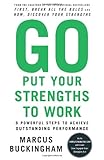
If you are interested in a more in-depth treatment of strengths and how to get a better picture of what your own strengths are, I would also recommend Buckingham’s book Go Put Your Strengths to Work.

Filed Under: Strengths

The Task of Defining Your Work

November 22, 2010 by Matt Perman

From David Allen’s latest newsletter (which you can subscribe to here), explaining why the world of work often seems so much harder now:

More and more these days I find that people in my seminars are resonating to the importance of defining our work. The challenge many of us face is to not only track, but accurately label all of our projects, and hang on to those “stakes in the ground” while the rest of the world seems to want to blow us away from them like we’re in a hurricane.

How many of you don’t have time to do your work, because you have so much work to do??!!

How many of you, in your jobs, are only doing what you were hired to do? (I never get one affirmative response in any group I query!)

I credit the late Peter Drucker for framing this issue better than anyone, from the macro perspective. He indicates that whereas fifty years ago 80% of our work force made its living by making or moving things, that number is now less than 20%. And that “knowledge work” demands a completely different paradigm of focus than we have been trained in as a professional culture.

The good news about making or moving something is that when you come to work, un-made and un-moved things make it real easy to know how to spend your day. You do not need “personal organization” other than the work that is obviously and visibly at hand. The bad news is that these days only a small percentage of us get to work and know what to do. The rest of us have to make it up. And very few (if any) of the people we interact with seem to be supporting our agenda.

So, it becomes critical for each of us to maintain a complete and accurately defined list of Projects, and to ensure that we review these at least weekly with real sincerity of focus, creating and capturing all the “oh yeah, that reminds me, I need to…” kind of next actions that need to happen to make our “work” happen.

This needs to include all the professional and personal projects about which you would like ideally for something to be happening during the course of an operational week. “R&D new camera”, “Finalize budget implementation”, “Refinance house”, “Reorganize office”, etc.

We were only trained and equipped in our culture to show up, and deal with the work at hand. We now have to train and equip ourselves, create our own targets and goal-lines, and tie safety ropes onto those outcomes to keep steady in our course against the winds of the world.

Filed Under: Workflow

Productivity is Really About Good Works

November 12, 2010 by Matt Perman

That’s essentially the thesis of my upcoming book and it was the main point in my seminar at the Desiring God national conference last month.

There are lots of reasons we care about productivity — we might want to have less stress, we might want to get more done in less time, or we might simply find the subject interesting in itself. And those are all good reasons.

But there are deeper, better reasons to care about productivity. There are, in fact, some amazing and incredible reasons to care about productivity that I am seeing almost no one ever talk about.

Chief among these reasons to care about productivity is this: Productivity is really about good works.

That’s worth saying again: Productivity is really about good works — which we were created in Christ to do (Ephesians 2:10) and which we are to do eagerly and enthusiastically (Titus 2:14). That’s why productivity matters, and that’s why I write about productivity. My aim is to help Christians be effective in good works.

This changes how you think about everything.

It means that when you are getting your email inbox to zero, you aren’t just getting your email inbox to zero. You are doing good works. When you are going to a meeting, you aren’t just going to a meeting. You are doing good works. Everything that we do as Christians, in faith, is a good work.

And therefore we are doing good works all day long — and consequently need to learn how to be more effective in them so that we can be of greater service to others.

And that’s where understanding productivity and productivity practices comes in. By learning how to be more effective in our everyday lives — in all of the work and projects and initiatives and intentions that come our way — we are able to serve others more effectively.

Or, to put it another way: Everything we learn about productivity (and at all levels — work, life, organizations, and society), every productivity practice we might implement, and every productivity tool we might use, ultimately exists for the purpose of helping to amplify our effectiveness in good works, for the glory of God.

That’s the essence of the framework in which, as Christians, we need to think about productivity.

Filed Under: 1 - Productivity, 7 - Theology

  • « Previous Page
  • 1
  • …
  • 21
  • 22
  • 23
  • 24
  • 25
  • …
  • 52
  • Next Page »

About

What’s Best Next exists to help you achieve greater impact with your time and energy — and in a gospel-centered way.

We help you do work that changes the world. We believe this is possible when you reflect the gospel in your work. So here you’ll find resources and training to help you lead, create, and get things done. To do work that matters, and do it better — for the glory of God and flourishing of society.

We call it gospel-driven productivity, and it’s the path to finding the deepest possible meaning in your work and the path to greatest effectiveness.

Learn More

About Matt Perman

Matt Perman started What’s Best Next in 2008 as a blog on God-centered productivity. It has now become an organization dedicated to helping you do work that matters.

Matt is the author of What’s Best Next: How the Gospel Transforms the Way You Get Things Done and a frequent speaker on leadership and productivity from a gospel-driven perspective. He has led the website teams at Desiring God and Made to Flourish, and is now director of career development at The King’s College NYC. He lives in Manhattan.

Learn more about Matt

Newsletter

Subscribe for exclusive updates, productivity tips, and free resources right in your inbox.

The Book


Get What’s Best Next
Browse the Free Toolkit
See the Reviews and Interviews

The Video Study and Online Course


Get the video study as a DVD from Amazon or take the online course through Zondervan.

The Study Guide


Get the Study Guide.

Other Books

Webinars

Follow

Follow What's Best next on Twitter or Facebook
Follow Matt on Twitter or Facebook

Foundational Posts

3 Questions on Productivity
How to Get Your Email Inbox to Zero Every Day
Productivity is Really About Good Works
Management in Light of the Supremacy of God
The Resolutions of Jonathan Edwards in Categories
Business: A Sequel to the Parable of the Good Samaritan
How Do You Love Your Neighbor at Work?

Recent Posts

  • How to Learn Anything…Fast
  • Job Searching During the Coronavirus Economy
  • Ministry Roundtable Discussion on the Pandemic with Challies, Heerema, Cosper, Thacker, and Schumacher
  • Is Calling Some Jobs Essential a Helpful Way of Speaking?
  • An Interview on Coronavirus and Productivity

Sponsors

Useful Group

Posts by Date

Posts by Topic

Search Whatsbestnext.com

Copyright © 2026 - What's Best Next. All Rights Reserved. Contact Us.