A good post by Justin Buzzard from a couple of years ago, but still very relevant. He quotes Clive Thompson, who postulates that it may be a good and productive thing for our minds to wander.
Great Leaders are Strengths-Based
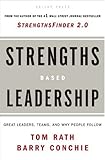
The Gallup Management Journal has a good interview with Tom Rath and Barry Conchie, authors of Strengths-Based Leadership, about some of their key findings from the book. Here’s one that stands out and should be encouraging: effective leaders don’t try to be someone else or even become well-rounded; instead, they know their strengths and focus on leading from those — which means that there are all sorts of different ways to lead. (Note: That doesn’t mean you can just do anything and be effective; the key point is that your particular style emerges from your strengths, not from a random or uninformed decision.)
It looks like you have to register to read the whole thing, but here are a few key highlights.
1. Concentrate on developing your talents into strengths, not fixing weaknesses or imitating others:
Here are some questions that leaders often ask themselves: How can I fix my weaknesses to be a more complete leader? How can I emulate the traits of the great leaders who preceded me? What should I focus on — vision or strategy? Here is the answer to all those questions: Don’t bother.
Concentrating on those issues will only distract you from the most important aspect of leadership: your natural talents, which can be developed into strengths. According to Tom Rath and Barry Conchie, coauthors of Strengths Based Leadership: Great Leaders, Teams, and Why People Follow, strengths are what make leaders great.
We all have natural talents, of course, but the greatest leaders are highly aware of theirs. They know what they’re good at and spend countless hours making themselves better at what they do best. They don’t try to make themselves well-rounded or like some other leader. Nor do they devote their energies solely to the relentless pursuit of strategy, vision, or any other ideal. And what they don’t do well, they hire someone else to do.
2. If you’ve taken the “Strengths Finder” test to examine your talent themes, these themes don’t of themselves say anything about whether you can be an effective leader. You lead effectively by harnessing your unique talents, whatever they may be:
GMJ: Of the thirty-four talent themes that the Clifton StrengthsFinder assessment identifies, which are the most common among great leaders?
Barry Conchie: I’ve got a problem with the question.
GMJ: Why?
Conchie: There is no single characteristic or set of characteristics that would enable us to determine an effective leader. The most effective leaders are the ones who figure out how best to use what they’ve got. So it matters less what the strengths are in terms of the themes; what’s key is that the leaders understand the strengths they have, how those strengths help them to be effective, and that they use strategies and methods to deploy their strengths to the greatest effect
Rath: I think that from all the research that Gallup’s done on leadership over the last three or four decades, the broadest discovery is that there is no universal set of talents that all leaders have in common. As we looked through these data and ran through hundreds of transcripts and individual interviews, we were struck by just how different all these leaders are.
If you were to sit down with each of the four leaders we featured in the book [Brad Anderson, vice chairman and CEO of Best Buy; Wendy Kopp, CEO and founder of Teach For America; Simon Cooper, president and CEO, The Ritz-Carlton Hotel Company, LLC; and Mervyn Davies, chairman, Standard Chartered Bank], you’d notice that they do things very differently based on their strong awareness of their unique talents.
I expand about this a bit more in my post “Leading From Your Strengths May Look Unusual,” where I quote from their chapter on Brad Anderson’s unique leadership style at Best Buy.
I would want to qualify one thing from their point here, though. While you can lead effectively with any of the talent themes identified by the Strengths Finder test, there are two qualities (not measured by the test) which, following Marcus Buckingham (see his excellent discussion in The One Thing You Need to Know: … About Great Managing, Great Leading, and Sustained Individual Success), I would argue are essential to leadership. The qualities are optimism and ego.
“Ego” doesn’t have to have the negative connotations we often associate with it; it simply means you believe that you are the one to lead and are fiercely committed to the task. Optimism is necessary because the essence of leadership is to rally people to a better future, and nobody will want to follow someone who doesn’t believe that they can make the future better. (Thinking that you can’t make a difference would be contrary to the nature of leadership altogether — where are you leading if not to someplace better?)
Understanding the nature of leadership as rallying people to a better future also enables you to focus on your strengths more effectively. For, as I talk about in my post “What Does a Leader Do?,” you don’t have to focus on developing long lists of recommended attributes for leaders when you know the core of the matter. Instead, focus on the core, and develop your own unique strengths.
3. Seeking to be well-rounded leads to mediocrity:
GMJ: You wrote: “If you spend your life trying to be good at everything, you will never be great at anything. While our society encourages us to be well-rounded, this approach inadvertently breeds mediocrity.” Why is that?
Conchie: The great leaders we’ve studied are not well-rounded individuals. They have not become world-class leaders by being average or above-average in different aspects of leadership. They’ve become world-class in a relatively limited number of areas of leadership. They’ve recognized not only their strengths but their deficiencies, and they’ve successfully identified others who compensate for those deficiencies.
The concept of well-roundedness is illusory. It might sound desirable from a developmental perspective, but really all that happens when people try to fix their weaknesses is that they spend inordinate amounts of time trying to become marginally better in an area that will never be particularly strong for them. So they’ll get far less of a return by trying to shore up relatively mediocre capabilities because they’ll probably always be below average in those areas. Leadership is not a construct of well-rounded attributes; it’s nearly always the consequence of some pretty incisive talents that are relatively specific and slightly narrow in focus being leveraged to the maximum.
The Core Productivity Decision in an Age of Infinite Input
Namely: input versus output. Godin makes a great point on this today:
[Input versus output] is one of the most important decisions you’ll make today.
How much time and effort should be spent on intake, on inbound messages, on absorbing data…
and how much time and effort should be invested in output, in creating something new.
There used to be a significant limit on available intake. Once you read all the books in the college library on your topic, it was time to start writing.
Now that the availability of opinions, expertise and email is infinite, I think the last part of that sentence is the most important:
Time to start writing.
Or whatever it is you’re not doing, merely planning on doing.
3 Strategies for Recovering from Information Overload
An article from the McKinsey Quarterly. Here’s the first paragraph:
For all the benefits of the information technology and communications revolution, it has a well-known dark side: information overload and its close cousin, attention fragmentation. These scourges hit CEOs and their colleagues in the C-suite particularly hard because senior executives so badly need uninterrupted time to synthesize information from many different sources, reflect on its implications for the organization, apply judgment, make trade-offs, and arrive at good decisions.
On Pricing E-Books
Godin explains why it is necessary for e-books to be priced differently than hard covers.
Managers: You Need to Give People More Freedom Than You Might Think
Jack Welch:
The old organization was built on control, but the world has changed. The world is moving at such a pace that control has become a limitation. It slows you down. You’ve got to balance freedom with some control, but you’ve got to have more freedom than you ever dreamed of.
Beware of Performance Load
Being competent is a good thing, but you need to be aware of one danger: “If not controlled, work will flow to the competent man until he submerges” (Charles Boyle). So if you aren’t deliberate about it, your competence can actually be your undoing.
This is the issue of performance load. Here’s how Josh Kaufman explains it in The Personal MBA:
Being busy is better than being bored, but it’s possible to be too busy for your own good.
Performance load is a concept that explains what happens when you have too many things to do. Above a certain point, the more tasks a person has to do, the more their performance on all of those tasks decreases.
Imagine juggling bowling pins. If you’re skilled, you may be able to juggle three or four without making a mistake. The more pins that must be juggled at once, the more likely you are to make a mistake and drop them all.
If you want to be productive, you must set limits. Juggling hundreds of active tasks across scores of projects is not sustainable: you’re risking failure, subpar work, and burnout. Remember Parkinson’s Law: if you don’t set a limit on your available time, your work will expand to fill it all.
Part of setting limits means “preserving unscheduled time to respond to new inputs.” This is necessary to handle the unexpected. And this means we must recognize that downtime is not wasteful. Kaufman goes on:
The default mind-set of many modern businesses is that “downtime” is inefficient and wasteful — workers should be busy all the time. Unfortunately, this philosophy ignores the necessity of handling unexpected events, which always occur. Everyone only has so many hours in a day, and if your agenda is constantly booked solid, it’ll always be difficult to keep up with new and unexpected demands on your time and energy.
Schedule yourself (in terms of appointments and projects) at no more than 80% capacity. Leave time to handle the unexpected. And to enable yourself to do this, realize that, counterintuitively, people (and systems — this is true of highways, airports, and all sorts of things) become less efficient when operating at full capacity, not more, and that downtime can actually increase productivity. If you keep these things in mind, you can help prevent your competence from being your undoing.
Don't Try to Fit Creative Tasks in Between Administrative Tasks
Josh Kaufman describes this well in The Personal MBA:
If you’re trying to create something, the worst thing you can possibly do is to try to fit creative tasks in between administrative tasks — context switching will kill your productivity. The “Maker’s Schedule” consists of large blocks of uninterrupted time; the “Manager’s Schedule” is broken up into many small chunks for meetings. Both schedules serve different purposes — just don’t try to combine them if your goal is to get useful work done.
When he says “don’t try to combine them,” he means, “don’t try to do them at the same time.” Most of us have things to make and things to manage (and wouldn’t want it any other way), and Kaufman gives a good model of how to integrate both into your day without creating interference between them:
I typically focus on writing for a few uninterrupted hours in the morning, then batch my calls and meetings in the afternoon. As a result, I can focus on both responsibilities with my full attention.
That’s a good approach: a large chunk of time for creative tasks in the morning, with the mid-day and afternoon free for those things that require dividing your time into smaller chunks and going with the flow.
You Don't Need to Know it All
A good word from Josh Kaufman in his book The Personal MBA:
One of the beautiful things about learning any subject is the fact that you don’t need to know everything — you only need to understand a few critically important concepts that provide most of the value. Once you have a solid scaffold of core principles to work from, building upon your knowledge and making progress becomes much easier.
Along with this, Kaufman quotes Ralph Waldo Emerson’s helpful point on methods and principles, which is good to keep in mind:
As to methods, there may be a million and then some, but principles are few. The man who grasps principles can successfully select his own methods. The man who tries methods, ignoring principles, is sure to have trouble.
Management in Light of the Supremacy of God How Should Christians Think About Management?
Christians should care about whether the organizations they work in are managed well and, if they are managers themselves, they should manage well.[1] This is first of all because, as Patrick Lencioni points out, management is a form of ministry. Lencioni writes:
I have always thought it was a shame that more people don’t go into “giving” professions. In fact, I have occasionally felt pangs of guilt that I didn’t choose a career that was completely focused on serving others. I have deep admiration for dedicated and hard-working clergy, social workers, or missionaries, and I wonder why I haven’t abandoned my career and moved into one of those kinds of jobs.
While I have not completely abandoned the idea of one day doing that, I have come to the realization that all managers can — and really should — view their work as a ministry. A service to others.
By helping people find fulfillment in their work, and helping them succeed in whatever they’re doing, a manager can have a profound impact on the emotional, financial, physical, and spiritual health of workers and their families. They can also create an environment where employees do the same for their peers, giving them a sort of ministry all their own. All of which is nothing short of a gift from God.
And, second of all, this is because an organization will be exponentially more effective in accomplishing its mission if it is well managed.
But what does it mean to manage well? Interestingly, effective management is not first about the nuts and bolts, or the details that most people would find un-interesting. Effective management, above all, means managing from a well thought point of view that is based upon how humans are created and has the supremacy of God as its ultimate aim. This kind of management is anything but boring.
What are the components of an effective management philosophy that is based upon the fact that humans are in the image of God and that the glory of God is the goal of all things? I am going to outline eleven.