What's Best Next

  • Newsletter
  • Our Mission
  • Contact
  • Resources
    • Productivity
    • Leadership
    • Management
    • Web Strategy
    • Book Extras
  • Consulting & Training
  • Store
    • Online Store
    • Cart
    • My Account
  • About
    • Our Mission
    • Our Core Values
    • Our Approach to Productivity
    • Our Team
    • Contact
You are here: Home / Archives for 9 Other Resource Types

The Table of Contents for What's Best Next

March 5, 2014 by Matt Perman

Here’s the table of contents for the book, What’s Best Next: How the Gospel Transforms the Way You Get Things Done.

Table of Contents 1

Table of Contents 2

Table of Contents 3

Table of Contents 4

You can also find out more about the book on the page for it here on the blog, and of course it is available at Amazon, Barnes & Noble (especially useful today, as Amazon is sold out), and WTS Books (which has a fantastic deal on bulk orders–buy 5 or more at 50% off).
Filed Under: 1 - Productivity, WBN the Book

User Reviews of What's Best Next

March 5, 2014 by Matt Perman

Here are some of the especially notable and cool comments people have been making on the book on Twitter, Facebook, blogs, and the Amazon reviews. (I considered a bit whether to do this, but I want to highlight what people are saying, and also say “thanks!”)

Facebook:

“My friend Matt Perman has written the most helpful book on productivity from a gospel-centered perspective I have *ever* read, either as a mom or as a business woman. It’s already changed some entrenched-bad habits and helped me navigate through these crazy days of being a mom/wife/student/health insurance warrior. I can’t imagine what it could have done for my high tech career. It’s already sold out at Amazon, but here’s the link to reviews there anyway. Note that John Piper himself agrees with me, so I must be right.”

“Reading this book has been great. Each chapter contains practical illustrations, bulleted lists, callout boxes, and helpful acronyms. It’s neither condemnatory nor lax, neither overwhelming nor oversimplified. My hope is that you’ll be aware of this helpful resource and you’d want to learn more on the subject.”

Blogs:

“Perman helped me to see that the ordinary activities of my day might not be so ordinary after all. Returning a phone call might lead to an opportunity to encourage. Smiling at the check out clerk at the local store and sincerely asking about his or her day could be the first caring words he or she has heard all day. And organizing your schedule, your desk, and your to do lists, as mundane as these things may seem, are really the things that, if organized well, will result in freeing up more of your time to serve those around you.” (Jeff Kennon)

“If you read only one book this year, it should be What’s Best Next: How the Gospel Transforms the Way You Get Things Done by Matt Perman. Yes I mean that.

“The aim of the book is “to reshape the way you think about productivity and then present a practical approach to help you become more effective in your life with less stress and frustration, whatever you are doing.” And the book delivers.

Stop everything and read it.” (Matt Heerema)

“I love the subject of productivity. I love theology. I love the concept of stewardship, particularly time stewardship. I have bookshelves full of books related to those subjects. I’ve read every book, article, and blog post about time stewardship that I could get my hands (or my digital hands) on.

And What’s Best Next is the first book I would recommend to anyone wanting to take his or her time stewardship to the next level.” (Loren Pinilis)

Amazon:

“The rest of the book is broken up into seven parts. That sounds like a lot but they move fast. Perman is an engaging writer who doesn’t waste word in bringing his message to his readers. Over those seven parts, Perman explains why it’s had to get things done but why just getting things done isn’t enough. He presents a better–more realistic and purposeful–approach to effectiveness and productivity. This involves figuring out what’s most important and clarifying your roles. For Perman, the gospel of Jesus Christ becomes a key factor in this part of his productivity.”

“When I finally took the topic more seriously about a year ago, I found many helpful suggestions. But I didn’t feel ‘whole’ about the matter. Besides missing some of the big action pieces of productivity (which Matt speaks about), I was thinking about productivity all wrong. My starting point was wrong. Matt helped me see that I can’t take out the thread of biblical theology that so naturally weaves itself into how one thinks about work, particularly productive work. Beyond that, Matt weaves together in this one book the principles and practical applications of being productive that is connected to faith.”

“Make no mistake, this is no dry book. What’s Best Next is replete with clear examples and personal anecdotes to give more meaningful application of its principles. I found it difficult to stop reading at times because its conversational prose and eye-pleasing format lead me to want to continue to the next chapter and continue from the “what” and the “why” to get to the “how.” If you are serious about maximizing your time and efforts so you can be an effective steward what Christ has given, this book will be an asset to you.”

“What’s Best Next is sure to be a standard for many years to come.”

“May Be One of the Most Important Books of Our Decade.”

“This is the book I have been waiting for. I love the Bible and I love books on productivity & leadership. What’s Best Next is the first book that I have read that effectively connects both.”

“HOWEVER, THIS BOOK ISN’T JUST FOR CHRISTIANS. Though thoroughly saturated with excellently-done Christian theology, I believe that a non-Christian can get a lot out of this book as well. Any fans of Godin, Covey, Allen, Collins, or Ferris will love this book, which synthesizes all of the best productivity and management thinking out there, and puts it all together in a way unlike any other book I’m aware of. (And if another exists, please tell me!)”

Twitter:

“started reading #whatsbestnext – In ch 3 and already blown away! Just what I needed as I start up a business!”

“Take The 12 Myths About Productivity Quiz wp.me/pTOnf-4P4 cc @mattperman #whatsbestnext”

“One key concept I’m learning in @MattPerman’s new book on productivity is that of the importance of “intangibles.” ow.ly/ugb87”

“If you only read one productivity book, make sure it’s this one. What’s Best Next by @mattperman Out today: chrspb.lt/OXYL3v”

“A gospel-driven Christian is known for both their love and sound theology #whatsbestnext”

And, especially great:

“I am finding the book helpful and exciting! Thanks! I’ll be 80 this year and want to make the most of whatever more time God gives me.”

Amen to that. “So teach us to number our days that we may get a heart of wisdom” (Psalm 90:12).

Filed Under: WBN the Book

What's Best Next Has Broken into the Top 500 at Amazon

March 4, 2014 by Matt Perman

It is amazing to watch this and see so many people talking about the book on Twitter, their blogs, and Facebook. Thank you to everyone and keep it going!

Having broken into the top 500 at Amazon, I wonder if we can break past the #250 mark, or higher.

Certainly it’s not the numbers that matter, but this is a way of exposing the book to people who would not otherwise know about it.

So if you haven’t picked up your copy of the book, today would be a good day to grab your copy at Amazon or WTSBooks, and tell a friend about the book.

Update: Amazingly, we reached this goal and the book made it up to #244 last night.


Filed Under: WBN the Book

Understanding Productivity in a New Way: What's Best Next is Now Available! (And Why I Wrote It)

March 4, 2014 by Matt Perman

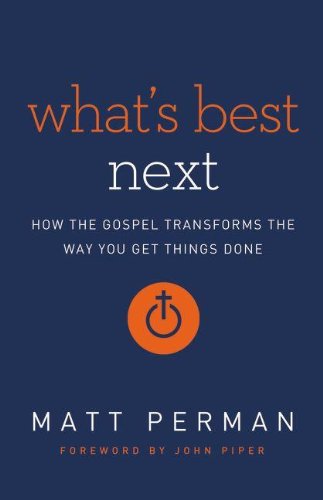
What's Best Next: How the Gospel Transforms the Way You Get Things Done

Finally, after two years of writing and many months of preparing for launch, my book What’s Best Next: How the Gospel Transforms the Way You Get Things Done has been released and is now availabe.

It has been a long road!

Why We Need This Book (and Why I Wrote It)

I wrote the book because I believe that this is what the church most needs to hear most of all right now, at this point in time. And this is slightly ironic, because this is a very practical book and a practical subject, yet I am more of a theologian by nature. In college I spent most days reading theology, writing articles to remember what I wrote, debating atheists and Jehovah’s Witnesses for fun, and talking about these things with my friends. After college, I studied under John Piper (who wrote the foreword) and got my M.Div. at Southern Seminary. You would have thought my first book would be on theology.

But there are lots of books on theology now (and, to be sure, we need more!). There has been an explosion of them in the last ten years (which, again, is a really fantastic thing). What we are lacking now are solid books on the very practical realities we are all dealing with in this new, ultra-connected world of work (and life!) that has emerged over the last twenty years — and that at the same time address these realities on a solid biblical, theological foundation.

And we absolutely need to address these realities, because productivity, managing ourselves, and getting things done are things we all deal with every day. Further, the Scriptures call us to think about all of life in relation to the gospel. Hence, it is critical that we think about productivity and how to get things done in a God-centered, gospel-driven way.

Yet, there are almost no books out there right now that seek to do that.

There are lots of secular books on productivity which are incredibly helpful (I am indebted to David Allen’s Getting Things Done, obviously, and  many more). But none of these books show how our productivity and the things we do every day connect to God and the gospel. On the other hand, over on the biblical side of things, there are very few books (almost none) that give serious reflection to productivity from a biblical perspective while also providing best-in class productivity practices and tips, of the same caliber of books like Getting Things Done or Stephen Covey’s very helpful First Things First. 

So that’s what my book seeks to do.

More specifically, I seek to do two things.

The First Aim of the Book: Present a Biblical Vision of Our Productivity and the Things We Do Every Day in a Unique, Compelling Way

First, I seek to give a biblical vision for how we are to think about our work, productivity, and the things we do every day. The lack of teaching in the church on how our faith relates to our work is one of the reasons that so many struggle with meaning in their work. I seek to show how amazing and surprising the biblical vision for our work and productivity really is (and how relevant it is). Some of the most interesting and significant things we see here are:

A (More Biblical!) Way of Understanding Good Works

We see that good works are not just rare and special things we do, like going to Africa, or spiritual things like leading a Bible study, but anything we do in faith—even tying our shoes. Hence, our vocations are actually one of the chief arenas in which we can serve and worship God. This gives great meaning to the things we do every day (the greatest possible!).

Why it is Absolutely Essential, and not Optional, to Consider Productivity in Relation to God

Lots of books on productivity talk about organizing our lives around “what matters most.” But God is what matters most! Yet none of those secular books — as important as they are — make that point.

We can’t just assume this, or leave “what matters most” up to whatever we say it is. If God exists, then he is the most important reality in the universe, and therefore to truly care about “what matters most” means to care about and love God — and thus center our lives around him.

Therefore, any ultimately “productive” approach to life will have God at the center. Those who seek to be productive without God can do many great and wonderful things, which are to be commended; but we can only be eternally productive if we do everything we do in Christ and for the glory of God (John 15:5). This book fleshes that out, and shows why it is good news.

Why This Matters for Non-Christians as Well as Christians

This book is also written for those who are not Christians, though I recognize many might not be initially inclined to pick up a God-centered book on productivity.

I tried to write in such a way as to show why it is reasonable to consider the claims of Christ for anyone who cares about productivity. For if we care about being productive, shouldn’t we care about what is ultimately productive forever — namely, living our lives for Christ? It’s worth considering. That’s what I want to say (and show) to those who are not already approaching this from a God-centered point of view. And so, for example, I seek to show how Stephen Covey’s principle-centered approach to productivity (the best yet) naturally leads to something beyond that — namely, a God-centered approach.

While I hope that any non-Christians who read this book will give serious consideration to the claims of Christ, there is also much they will benefit from even if they do not take that path. I believe that, as Christians, we are to serve all people (Galatians 6:10; 1 Thessalonians 3:12), and this book will be useful even to those who do not share my faith.

The Second Aim of the Book: Present a Practical Approach for Getting The Most Important Things Done that Actually Works

Then, after giving a biblical perspective for how we are to understand our productivity and work in a new way because of the gospel, I seek to provide a practical approach for improving our productivity in every area of life.

I seek to provide an approach that is simple, yet deals with all levels of our work and lives. Those who love GTD like I do will recognize GTD as a significant part of the framework (and I give many shout-outs to it), but this book is not a re-hash of GTD. I seek to develop it further, and also simplify it in many respects.

I seek to give an approach you can follow even if you aren’t in to having very many lists (though I do believe lists are very helpful and often necessary). Further, my approach is top-down (whereas GTD is bottom-up). I also integrate some of the best insights from books like Scott Belsky’s Making Ideas Happen, Peter Drucker’s The Effective Executive, and many others.

Some of the things you will learn in these sections include:

Mission Statements (that work! and aren’t stuck in the 80s…)

Mission statements matter! But many don’t work well for people, because we do it wrong. So we look at how to create a mission statement for your life that actually works (and why this matters).

Identifying Your Life Calling

It is also important to know how to identify your chief calling in life — the one thing you are most fully on the planet to do (note: this is actually something different from your mission statement), and do it in a God-centered way. This can be especially helpful when having to make career decisions and other major life decisions.

Creating a Flexible Framework (Time Map) for Your Week

Even when you know your chief priorities, they don’t happen automatically because systems trump intentions. Hence, you need to weave them into the fabric of your life through a flexible framework so they actually get done.

This is most of all done through creating a flexible time map for your week. In these chapters, we also get some glimpses into how the president schedules his day (I interviewed one of president Bush’s former schedulers in preparation for this book) and how Christian leaders like Al Mohler get things done.

Delegating–in God-Centered Way
We look at how to delegate in a way that actually works and empowers people, rather than treating them like machines or gophers.

If we are to be God-centered in everything, that includes delegation! There is a way to be God-centered in our delegation that we often overlook, and is fundamental to what it means to treat people with respect and dignity (which are fundamental to any God-centered approach to life — if we are to honor God, then we must honor people, who are made in his image; this is non-negotiable, and has to be reflected in the way we go about our work). God-centerd delegation means delegating to people in a way that truly empowers them and hands over real responsibility. It is based on trust. We look at what this means, and how to do it well.

Processing Workflow, Managing Projects, and the Details of Execution
And, of course, we look at how to get things done in the moment by learning how to process workflow and get your email inbox to zero every day, how to manage projects and keep track of all your actions and information through simple project plans, how to plan your week, and the six routines you need to have in your week.

The Last Section: The Results of Gospel-Driven Productivity

Then, in the final section, I show how all of this connects to God’s global purposes, including productivity in our organizations and society, and ultimately world missions. Ultimately, we see that as we are productive in a God-centered way in every area of our lives, God transforms the world through our work socially, economically, and spiritually. (And, perhaps most interestingly, this is precisely what Paul teaches in Ephesians 5:8-17, the core New Testament passage on time management.)

(And Some Other Things)

That’s a quite-extended snapshot of the book, and there are still many, many things I left out! I will be posting on the book throughout the week to give you shorter snapshots and some of the other key take-aways, including the D-A-R-E process that I use to summarize and integrate all of these things in a way that (hopefully) makes it easy to remember.

Some Blog Posts on the Book So Far

Several people have blogged on the book so far, and there are many more posts to come that I am aware of. Here are a few of the key posts so far:

  • Justin Taylor’s post on What’s Best Next
  • Matt Heerema’s post The One Book You Should Read This Year
  • Andy Naselli’s post (with a great summary of the book and the table of contents)
  • Joshua Van Der Merwe’s post Three Reasons You Should Read What’s Best Next by Matt Perman 

Here are also some other resources on the book you might find useful:

  • The page for the book on this site, with all the endorsements, a briefer summary than this post (!), a sample of the book, and more.
  • John Piper’s foreword for the book.

Some Reader Comments

I suppose I should also list some of the endorsements. I’ll post just a few for now, but you can see all of them on the page for the book listed just above.

Perhaps most interesting are some of the comments I’ve received from other advance readers so far. Here are a few:

“This book has such fruit-bearing potential I wish I’d started a blog years ago for the sole purpose of recommending it today. If you struggle to manage the number of things on your plate and want to serve people more effectively with the time that you have, you need to embrace and apply the principles in this book.”

“The table of contents made me want to stay up all night.”

And, here are three of the endorsements:

“This book is simply extraordinary…. I doubt there is a person on the planet who knows both theological issues and time-management literature to the depth and extent Matt Perman does.”

—John Piper, founder and teacher, desiringGod.org; author, Don’t Waste Your Life

“In this amazing volume, Matt Perman offers a wealth of practical, real-world productivity solutions, all framed within the context of the Gospel. He provides the know-how and the know-Who we need to be faithful stewards over the gifts we have been given.”

—Michael Hyatt, New York Times bestselling author of Platform; MichaelHyatt.com

“As Christians, we are called by God to work with all our heart, because our work is—or should be—directly for the Lord. But beyond platitudes no one has really approached being productive at working, until now. Matt Perman approaches the task not only from his personal experience, but from a Christian worldview. Follow his model to align what you do with God’s purpose in your life—and in particular in your work.”

—B. Joseph Pine II, co-author, The Experience Economy

In Sum: Read the Book!

At the end of the day, I think the best way to experience the book is to read it! So I encourage you to pick up a copy, either in hardcover (Zondervan did an amazing job — it is a truly beautiful book) or for an eReader like Kindle.

(And Share It…)

Last of all: consider sharing the book with others by telling them about it, whether through tweeting this post or any of those listed above, tweeting anything else about the book, or through emailing them the Amazon page (here’s the link again: http://bit.ly/whatsbestnext) or through any other means.

There is a growing movement of gospel-centered Christians that are incredibly good at what they do in their jobs, and are excited about seeing all of life in light of the gospel. This book aims to help give a lift to that movement, which truly consists of all Christians who are eager to serve the Lord to the max with all of their gifts, without burning themselves out in the process.

I hope you enjoy the book and find it very helpful.

And, let me know what you think!

Filed Under: 1 - Productivity, WBN the Book

Join the Launch Team for What's Best Next!

February 21, 2014 by Matt Perman

My book What’s Best Next: How the Gospel Transforms the Way You Get Things Done, releases March 4. You’ve been hearing about it for a long time now, and thanks for all of the encouraging words that so many of you have sent me over the last couple of years. It’s been a long journey and I’m really excited for its release!

If you are interested in being a part of the launch for the book, I’d love to have you as part of the launch team.

What You’ll Get

Here are some of the benefits of being a What’s Best Next launch team member:

  1. A free electronic edition of the book in advance.
  2. Private Facebook group access.
  3. A half-hour teleseminar prior to launch on Friday, February 28.
  4. A thank you link back to your blog.
  5. A free copy of my ebook How to Set Up Your Desk (not yet published).
  6. A free PDF where I compiled a whole bunch of my research for the book (about 300 pages).

And, most importantly, it will be a lot of fun and you can help me get out a very important message on what it means to base our productivity in the gospel!

What You’ll Do

As a member of the launch team, here’s what you’ll do:

  1. Write a short review on Amazon or other e-tailer site.
  2. Spread the word using your platform during launch week (the week of March 4) and after, whether through Twitter, Facebook, your blog, or all of the above.
  3. Share ideas in the Facebook group on other ways to help get the word out about the book to as many people as we can.

(And, of course, note that you don’t have to be a part of the launch team to do these things (except item 3), so please feel free to do these whether you are a part of the launch team or not!)

How to Sign Up

To become a part of the launch team, just email me through the contact form on the blog by Tuesday, February 25. Send me your name and email, and we’ll get you hooked up with your electronic copy of the book, the Facebook group, and other details. It’s that simple!

(I suppose I should add that the team will be limited to a certain number of people; I’m actually not sure how many yet. But everyone who asks to join the team before we reach that cutoff point will be part of the team.)

More on the Book

You’ve heard some things about the book as I’ve blogged about it during the writing process, and the description is up at Amazon. I’ve also started building out the page for the book here on the blog, where you can see a brief description and all of the endorsements (including the ones I haven’t been able to get to show up yet at Amazon), as well as the link to John Piper’s foreword. I’ll also be blogging more on the book in the week leading up to release (next week).

Update: Thank you everyone who joined the team! We had over 100 people sign up, which is fantastic and amazing. If you missed the deadline, there are still many things you can do to help by blogging about the book, writing an Amazon review, tweeting about it, and posting to Facebook. If you would like to formally join the launch team, go ahead and contact me through the contact form here on the blog (link above) and we can still add you to the Facebook group.

Filed Under: WBN the Book

All My Posts from Catalyst Atlanta in One Spot

October 18, 2013 by Matt Perman

This post is part of the series Catalyst 2013.

Here are the links to all my posts from blogging Catalyst Atlanta this year:

Day One

  • Live Blogging Catalyst This Week
  • The Often Overlooked Tie Between Good Usability and Leadership
  • Why Insecure Leaders Are so Bad
  • Andy Stanley: Surviving Your Appetite for Being Known
  • Malcolm Gladwell: David and Goliath
  • Q&A with Malcolm Gladwell
  • John Piper: Glorifying God by Maximizing Our Joy in Him

Day Two

  • Update on Catalyst Blogging
  • Lecrae and the Doctrine of Vocation
  • Jud Wilhite’s Catalyst Message
  • Angela Ahrendt’s Interview at Catalyst
  • Dave Ramsey and Rachel Cruze’s Catalyst Message: Raising Your Kids to be Sound Financial Stewards
  • Cory Booker: Putting Purpose Over Position
  • Andy Stanley’s Closing Message at Catalyst: Leadership 101

Filed Under: Catalyst 2013

Andy Stanley's Closing Message at Catalyst: Leadership 101

October 18, 2013 by Matt Perman

This is part of the series Catalyst 2013. 

Andy Stanley’s closing message at Catalyst was fantastic. He went to the core, the foundation, that you need to understand in order to lead. These are the absolute basics, but they are almost never talked about. If you were at Catalyst and had to catch an early flight, I would especially suggest reviewing these notes so you can catch what you missed.

Here are my notes:

“Level 5 leaders have the humility to aspire to be the dumbest person in the room” — Jim Collins.

Today, it’s leadership 101. Taking it down to the most fundamental level. I had to do this to survive.

Here’s where this came from. When we started North Point, there was so much to do, and I felt early on it was getting too big too fast for me to keep up with. I have to reduce things to an irreducible minimum to keep my eye on the ball. So I wrote down off the top of my head what I’m about to give you to keep me centered. This is at the core and epicenter of my personal leadership.

So, when it starts getting confusing, and there are too many people demanding too many things, and you aren’t even sure what to focus on, this is what I retreat to. And perhaps we should all consider retreating to this. This is at the essence of where leadership begins.

Always have an answer to these 3 questions. If you can answer these, you’ll be OK.

  1. What are we doing?
  2. Why are we doing it?
  3. Where do I fit in?

Everybody in your department, student ministry, staff, everyone in whatever your organization is, ought to be able to answer these questions.

The very next thing you should do in regard to your leadership is wrestle these questions to the ground.

1. What are we doing?

This is a participle. “We are creating” or “We are building” or “we are leading.”

About 24 years ago, Stephen Covey wrote The Seven Habits of Highly Effective People. I got it right when it came out and couldn’t put it down. And there was a whole section on mission statements. Covey talks in there about the Ritz-Carlton, where mission statements had been embraced from the top of the organization all the way down. Part of their success was that everyone, even the cooks, had a mission statement. And I thought “can a maid really have a mission statement?” It turns out that the owner of the company was a friend of my dad, so I called him. I said “seriously?” Not disrespectfully, but I was wondering. We couldn’t even get our church to have a mission statement.

He said: “the only way to understand this is to go through our training for maids, cooks, and bellmen.” So we went and sat in on that training.

I cannot over emphasize the power of a statement that answers the question “what are we doing?”

In the training, the trainer brought everyone to a single statement: “we are ladies and gentlemen serving ladies and gentlemen.” It was empowering and dignifying to the staff. They saw they were people worthy of respect–just as much as the wealthy people they were serving.

“That’s when I became a raving fan of the importance of mission statements.”

Most decisions are pre-decided when the mission is crystal clear.

It is critical to push decisions down in the organization. The better leader you are, the fewer decisions you are making. And people are empowered to make good decisions by a clear and compelling mission statement.

You’ll never be great at what you’re doing if you don’t know what it’s for. There are no great organizations that aren’t clear on what they are doing.

Without a mission statement, you’ll have a hard time convincing others to join you. For they won’t know what you are doing.

Leaders love to work for people who have given them crystal clear marching orders.

I am always hearing from sharp leaders who are frustrated because their organizations don’t make it clear what the mission is.

There is something that rises up in a leader when it’s clear what we have come togehter to do. And there are few things more discouaring to a leader than to be given a responsibility that isn’t clear and tied in to a mission.

The reason you don’t have a simple and sticky mission statement is becuase you haven’t taken the time to create one.

Some people say “the local church is too complex and doing too many things; you can’t boil it down to one thing.” Oh yes you can. You just haven’t thought about it yet.

I’ll tell you what will happen when you do this: you will be perceived as the leader, you may make some waves, you may get fired, and we’ll hire you.

In 1997 Jobs comes back to Apple, and he says “Here’s what we are going to do: we are going to create easy to use computers. That’s what we do at Apple.” Boom.

For us, we decided we are going to create a church that unchurched people love to attend. And some years went by, and we said “let’s go create some churches unchurched people love to attend.”

My question for you is: what are you doing? One of the most healthy exercises is; your church probably already has a mission statement, and it’s way too long. If I were to ask you your mission, if you have to look away to remember it in order to say it, it’s too long. It needs to be short and memorable.

What’s the point of change if you don’t know what you’re trying to do? Change means you were going this direction and now you are going that direction. If you don’t know what that direction is, you can’t change. You aren’t changing.

What have you come together to do? If you can’t answer that question, you will never bring about meaningful, healthy change.

Wherever you have influence in the organization, start the conversation. “What are we doing?”

2. Why are we doing it?

The answer to this question is where you find your inspiration. This answers the qeustion “what’s at stake? What goes away if we go away? What problem goes unsolved? What question goes unanswered? What service goes unprovided?” When you drill down on why, you will find the emotion rising and rising.

Don’t be afraid to reach back to God’s personal call on your life to answer the question why.

Here’s why: your personal call is where you found the courage to take the first step. You have to stay close to that, because ministry requires courage. And your personal is where you are going to find your passion.

What was it that first got you into the ministry? Behind your call was a why. Go back to that. You need to tap into this even in your division and department and organization. This is not selfish, because you are a leader, and when leaders tap into their passion, they attract people with a similar passion. And before you know it, you have a movement.

That’s how great things are accomplished.

Some of you right now have a calling that is so deep, and so rich, but you’ve allowed it to become vanilla because you are in a place that has squashed it. Get out of there!!! You will wake up one day and say “what happened to me?”

My dad would say: “Don’t you ever, ever let money, don’t you ever let money stand in the way of what God has called you to do.”

Maybe just one person in this room, God wants to do something extraordinary through you; if you stay where you are too long, and let organizational structures constrain you and the fear of how you’ll pay your bills keep you back, not only will you miss out, thousands of people will miss out.

Step into the gap. It’s not about you are your ego, it’s that you can’t imagine devoting your life to anything else.

Why has the power to get you through the tough times. When you retreat back to why, you will find your energy.

3. Where do I fit in?

Ask yourself, “what is my unique contribution. What is my core responsibility?” If you could only do what you could do, you need to identify it and schedule accordingly.

Your organization will be at its best when you are doing what you do best. Your entire organization.

To drive this deeper, create a one sentence job description for each of your direct reports. This is time consuming, but it’s almost magic. No matter how big the job is, you can boil it down to one sentence. And when you do, it’s gold.

My one sentence: “Inspire our staff and congregations to remain fully engaged in our mission and strategy.”

Our CFO: “Create, implement, and monitor systems that ensure our organization remains fiscally secure.”

My administrative assistant: “To keep Andy’s path clear of nonessential tasks and decisions so that he can do what only he can do.”

Leadership team: “Create a lcoal church culture that inspires, empowers, and equips our staff and congregation to engage in our mission, strategy, and vision.”

Can you imagine what would happen in your department or division or church if even just 75% of the leaders could answer these 3 questions?


Filed Under: Catalyst 2013

Cory Booker: Putting Purpose Over Position

October 18, 2013 by Matt Perman

This is part of the series Catalyst 2013.

It was great to see Cory Booker interviewed at Catalyst this year. Cory couldn’t be there in person, but was interviewed at his office in advance, and the video was shown. Cory is the mayor of Newark, New Jersey and a candidate for the US senate.

(In the time since Catalyst [two weeks], it looks like he has won the election and become New Jersey’s first ever African American senator.)

Like Angela Ahrednt, it was refreshing to hear how biblical principles informed the way he thinks about his vocation. The Golden Rule (“how would I want others to treat me? treat them the same way”) is at the foundation of how he thinks about everything, which is exactly as it should be. As with Angela, we see again that this is not only the right way to be, but that it is also the way to truly be most effective in your work and life. It is, as I argue in my upcoming book, the essence of how to be truly productive.

Here are my notes from the interview:

Don’t get so obsessed with position. Purpose is more important than position. Ask “what gets me up in the morning? What excites me? Is it creating things, serving people, going on adventures? Stay loyal to your passion.”

“For me, it was having the courage to confront fear. There is an old definition of faith that has always helped me: faith is coming to the end of a dark tunnel and stepping out, and knowing that one of two things will happen. Either there will be solid ground beneath you, or God will bring people to help you fly.”

“This world is going to do a lot to try to make you conform, to try to fit you into boxes. That’s wrong. We were made to stand out. As Lincoln said: everyone was born an original, but most of us die copies.”

“When I was in my twenties, I had a lot of people coming to me and saying ‘you should do this.’ And I said ‘why? I don’t want to do that.'”

“You should take risks, especially in your twenties.”

Talent is important, but values are even more important.

A lady in the inner city said to him once “Only if you are one of those stubborn people who whenever they open their eyes see hope and opportunity no matter what, only then are you a person who can help me.”

“You cannot have extraordinary results without extraordinary effort.”

AMEN!!! Way to go, Cory.

Filed Under: Catalyst 2013

Jud Wilhite's Catalyst Message

October 17, 2013 by Matt Perman

From the series Catalyst 2013.

I had actually not heard of Jud Wilhite prior to attending Catalyst this year. Jud is an author, speaker, and senior pastor of Central Christian Church in Las Vegas, one of the fastest growing churches in American.

What stood out to me the most about Jud was his authenticity. That always goes a long way with me. As I mentioned in a previous post, I mixed it up between taking extensive notes on messages and taking just a few notes. I took just a few notes from Jud’s message so that the core points would stand out. Here they are:

“Everybody loves you until you lead.”

Embrace your unique calling in your life.

Love the calling you have, not the calling you wish you had.

Those are worth reflecting on.


Filed Under: Catalyst 2013

Final Message Notes from Catalyst Atlanta

October 17, 2013 by Matt Perman

OK, it’s time to (finally) finish posting my notes from Catalyst Atlanta. Sorry for the delay! I will schedule the rest of my notes to post between now and the end of the day tomorrow.

The last post will be Andy Stanley’s final message, which was especially fantastic because it gives the foundational concepts that every leader needs to know, but rarely hears.

Filed Under: Catalyst 2013

  • « Previous Page
  • 1
  • …
  • 9
  • 10
  • 11
  • 12
  • 13
  • …
  • 24
  • Next Page »

About

What’s Best Next exists to help you achieve greater impact with your time and energy — and in a gospel-centered way.

We help you do work that changes the world. We believe this is possible when you reflect the gospel in your work. So here you’ll find resources and training to help you lead, create, and get things done. To do work that matters, and do it better — for the glory of God and flourishing of society.

We call it gospel-driven productivity, and it’s the path to finding the deepest possible meaning in your work and the path to greatest effectiveness.

Learn More

About Matt Perman

Matt Perman started What’s Best Next in 2008 as a blog on God-centered productivity. It has now become an organization dedicated to helping you do work that matters.

Matt is the author of What’s Best Next: How the Gospel Transforms the Way You Get Things Done and a frequent speaker on leadership and productivity from a gospel-driven perspective. He has led the website teams at Desiring God and Made to Flourish, and is now director of career development at The King’s College NYC. He lives in Manhattan.

Learn more about Matt

Newsletter

Subscribe for exclusive updates, productivity tips, and free resources right in your inbox.

The Book


Get What’s Best Next
Browse the Free Toolkit
See the Reviews and Interviews

The Video Study and Online Course


Get the video study as a DVD from Amazon or take the online course through Zondervan.

The Study Guide


Get the Study Guide.

Other Books

Webinars

Follow

Follow What's Best next on Twitter or Facebook
Follow Matt on Twitter or Facebook

Foundational Posts

3 Questions on Productivity
How to Get Your Email Inbox to Zero Every Day
Productivity is Really About Good Works
Management in Light of the Supremacy of God
The Resolutions of Jonathan Edwards in Categories
Business: A Sequel to the Parable of the Good Samaritan
How Do You Love Your Neighbor at Work?

Recent Posts

  • How to Learn Anything…Fast
  • Job Searching During the Coronavirus Economy
  • Ministry Roundtable Discussion on the Pandemic with Challies, Heerema, Cosper, Thacker, and Schumacher
  • Is Calling Some Jobs Essential a Helpful Way of Speaking?
  • An Interview on Coronavirus and Productivity

Sponsors

Useful Group

Posts by Date

Posts by Topic

Search Whatsbestnext.com

Copyright © 2026 - What's Best Next. All Rights Reserved. Contact Us.