What's Best Next

  • Newsletter
  • Our Mission
  • Contact
  • Resources
    • Productivity
    • Leadership
    • Management
    • Web Strategy
    • Book Extras
  • Consulting & Training
  • Store
    • Online Store
    • Cart
    • My Account
  • About
    • Our Mission
    • Our Core Values
    • Our Approach to Productivity
    • Our Team
    • Contact
You are here: Home / Archives for Matt Perman

What the Internet is Doing to Our Brains

July 19, 2010 by Matt Perman

A friend of mine recently recommended The Shallows: What the Internet Is Doing to Our Brains. I haven’t read it yet, but it looks good. Here is a short description of some of the author’s findings:

Building on the insights of thinkers from Plato to McLuhan, Carr makes a convincing case that every information technology carries an intellectual ethic — a set of assumptions about the nature of knowledge and intelligence. He explains how the printed book served to focus our attention, promoting deep and creative thought. In stark contrast, the Internet encourages the rapid, distracted sampling of small bits of information from many sources. Its ethic is that of the industrialist, an ethic of speed and efficiency, of optimized production and consumption — and now the Net is remaking us in its own image. We are becoming ever more adept at scanning and skimming, but what we are losing is our capacity for concentration, contemplation, and reflection.
Filed Under: Technology

Managing Email with an Assistant

July 2, 2010 by Matt Perman

More good thinking from Michael Hyatt, this time on an approach to managing email with an assistant that really looks promising.

What’s helpful here is that Hyatt first discusses what didn’t work, and then outlines the process that they finally settled on.

Filed Under: 1 - Productivity

Scheduling Time in the Alone Zone

July 1, 2010 by Matt Perman

Good words from Michael Hyatt.

Filed Under: 1 - Productivity

How Not to Fall Behind by an Hour a Day

July 1, 2010 by Matt Perman

Some good observations from David Allen in Making It All Work:

Working your process takes time. As I described in chapter 6 on clarifying, it usually requires an hour a day just to stay current with the typical volume of information.

That’s a highly productive expenditure of time, during which you’ll be thinking, making decisions, completing short actions, routing data, communicating, and defining and organizing new work. But it’s not the kind of activity you can do while you’re working on longer tasks or in meetings.

Though many executives find it useful to leave the first hour or so of the morning open for it, processing time is something that you may not find easy to block out. Some people have a stable enough work environment to allow for clearing the decks first thing in the morning and last thing in the evening, but you may simply have to clean up your in-basket “between the lines” — whenever you can as you move through your day.

The critical factor is to be aware that it will take time. If you allow yourself to be booked in meetings through an entire day, you will fall at least an hour behind in your processing. There’s nothing inherently wrong with that, as long as you realize that you will have to “pay the Piper [that is, John Piper — just kidding!]” sometime soon. Many, however, don’t seem to realize or accept this reality and then operate in a constant state of frustration over having to make up the lost time. That’s like complaining that taking a shower eats into your day!

People who get accustomed to the true amount of time and energy required for these procedures begin to incorporate it into the stride of their life and work, instead of railing against it.

Filed Under: 1 - Productivity

The Difference Between Responsibilities and Tasks

June 30, 2010 by Matt Perman

Leave the Office Earlier explains this well:

There is a difference between a responsibility and a task. For example, “participate in team decisions” is a responsibility; “attend team meetings” is a task. “Communicate with customers” is a responsibility; “write monthly ezine is a task.” “Obtain market visibility” is a responsibility; “write article for trade journals” is a task. “Develop media relationships” is a responsibility; “create press releases” is a task.

The distinction hinges on the question, “Why do I do this?” The responsibility is high level, and the task is specific. One responsibility may carry five (or more) associated tasks. If you can eliminate one responsibility through clarification, you may eliminate several tasks. You carry out tasks to fulfill responsibilities.

Filed Under: 1 - Productivity

Questions on Time Management

June 29, 2010 by Matt Perman

Here are some good questions from Shopping for Time: How to Do It All and Not Be Overwhelmed:

  • Do you plan ahead to maximize your fruitfulness each day, or do you simply let life happen?
  • Do you make choices based on Scripture or on what feels good at the moment?
  • Do you strategize to use your talents to bless your family and church, or do you employ them primarily for your own personal fulfillment?
  • Do you evaluate every opportunity in light of biblical priorities, or do you do whatever it takes to get ahead?
  • Do you consider whom God would have you serve, or do you try to please everyone all the time?

Filed Under: 1 - Productivity

The Power of Full Engagement

June 28, 2010 by Matt Perman

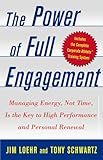
If you have a tendency to work too much (or not enough!), I highly recommend The Power of Full Engagement: Managing Energy, Not Time, is the Key to High Performance and Personal Renewal. I’ve been dipping into it a bit and, while parts of it can seem like too much of a step-by-step program (for lack of a better term) at times, it has a lot of helpful insight.

Here are a few quotes:

“Managing time efficiently is no guarantee that we will bring sufficient energy to whatever we are doing” (4).

“The performance demands that most people face in their everyday work environments dwarf those of any professional athletes we have every trained” (8).

“Sadly, the need for recovery is often viewed as evidence of weakness rather than as an integral aspect of sustained performance” (12).

Maximum performance comes by “alternating periods of activity with periods of rest” (28).

“Nearly every elite athlete we have worked with over the years has come to us with performance problems that could be traced to an imbalance between the expenditure and the recovery of energy. They were either overtraining or undertraining in one or more dimensions — physically, emotionally, mentally or spiritually. Both overtraining and undertraining have performance consequences that include persistent injuries and sickness, anxiety, negativey and anger, difficulty concentrating, and loss of pasion. We achieved our breakthroughs with athletes by helping them to more skillfully manage energy — pushing themselves to systematically increase capacity in whatever dimension it was insufficient, but also to build in regular recovery as part of their training regimens. Balancing stress and recovery is critical not just in competitive sports, but also in managing energy in all facets of our lives. When we expend energy, we draw down our reservoir. When we recover energy, we fill it back up. Too much energy expenditure without sufficient recovery eventually leads to burnout and breakdown. (Overuse it and lose it.) Too much recovery without sufficient stress leads to atrophy and weakness. (Use it or lose it.)” (29)

“To the degree that leaders and managers build cultures around continuous work…performance is necessarily compromised over time. Cultures that encourage people to seek intermittent renewal not only inspire greater commitment, but also more productivity” (30).

“You can always find reasons to work. There will always be one more thing to do, but when people don’t take time out, they stop being productive” (35).

“When we operate at a high enough intensity for long enough, we progressively lose the capacity to shift to another gear” (39).

By advocating that we don’t overwork, however, they aren’t arguing that we coast. Rather, the periods of activity should often push us beyond our limits. The key is that you also have to punctuate these times with sufficient periods of rest and recovery. Here’s a good overall summary of that point, which is one of the key points of the book:

“When we first suggested to Roger B. that he lacked sufficient capacity in part because he hadn’t exposed himself to sufficient stress, he was incredulous. ‘My life is more stressful than ever,’ he insisted. ‘I’m getting less help from my boss, and I’ve got more people to supervise, fewer resources and more competition. If what you’re saying is right, how come I’m not getting stronger?’ Many of our clients initially raise the same question.

“The answer, we tell them, is that the key to expanding capacity is both to push beyond one’s ordinary limits and to regularly seek recover, which is when growth actually occurs [this is just like with weight training, or running, or swimming, and so forth]. There was no area of Roger’s life in which he was doing both. At the physical and spiritual level, he wasn’t spending enough energy to build capacity. Because he was undertraining those muscles, they continued to atrophy.

“In the other two dimensions — mental and emotional — Roger was overtraining, subjecting himself to excessive stress without sufficient intermittent recovery. The result was that he felt overwhelmed. His solution was simply to keep pushing. What he needed was time to detoxify and change channels in order to periodically renew mentally and emotionally. Roger was pushing himself too hard in some dimensions and not hard enough in others. The ultimate consequence was the same: diminished capacity in the face of rising demand.

Filed Under: 1 - Productivity

The Beatles and Multitasking

June 24, 2010 by Matt Perman

This is a good post by Matt Blick.

Filed Under: Multi-tasking

John Piper on Productivity

June 23, 2010 by Matt Perman

This a great paragraph from Piper’s article The Marks of a Spiritual Leader:

A leader does not like clutter. He likes to know where and when things are for quick access and use. His favorite shape is the straight line, not the circle. He groans in meetings that do not move from premises to conclusions but rather go in irrelevant circles. When something must be done he sees a three-step plan for getting it done and lays it out. A leader sees the links between a board decision and its implementation. He sees ways to use time to the full and shapes his schedule to maximize his usefulness. He saves himself large blocks of time for his major productive activities. He uses little pieces of time lest they go to waste. (For example, what do you do while you are brushing your teeth? Could you set a magazine on the towel rack and read an article?) A leader takes time to plan his days and weeks and months and years. Even though it is God who ultimately directs the steps of the leader, he should plan his path. A leader is not a jellyfish that gets tossed around by the waves, nor is he an oyster that is immovable. The leader is the dolphin of the sea and can swim against the stream or with the stream as he plans.

(HT: Eric McKiddie)

Filed Under: 3 - Leadership

Goodreads

June 23, 2010 by Matt Perman

Goodreads seems to be worth checking out. It provides an easy, online way to keep track of what you are reading and recommend books to others.

(A recent commenter pointed pointed this out to me — thanks!)

Filed Under: Reading

  • « Previous Page
  • 1
  • …
  • 86
  • 87
  • 88
  • 89
  • 90
  • …
  • 151
  • Next Page »

About

What’s Best Next exists to help you achieve greater impact with your time and energy — and in a gospel-centered way.

We help you do work that changes the world. We believe this is possible when you reflect the gospel in your work. So here you’ll find resources and training to help you lead, create, and get things done. To do work that matters, and do it better — for the glory of God and flourishing of society.

We call it gospel-driven productivity, and it’s the path to finding the deepest possible meaning in your work and the path to greatest effectiveness.

Learn More

About Matt Perman

Matt Perman started What’s Best Next in 2008 as a blog on God-centered productivity. It has now become an organization dedicated to helping you do work that matters.

Matt is the author of What’s Best Next: How the Gospel Transforms the Way You Get Things Done and a frequent speaker on leadership and productivity from a gospel-driven perspective. He has led the website teams at Desiring God and Made to Flourish, and is now director of career development at The King’s College NYC. He lives in Manhattan.

Learn more about Matt

Newsletter

Subscribe for exclusive updates, productivity tips, and free resources right in your inbox.

The Book


Get What’s Best Next
Browse the Free Toolkit
See the Reviews and Interviews

The Video Study and Online Course


Get the video study as a DVD from Amazon or take the online course through Zondervan.

The Study Guide


Get the Study Guide.

Other Books

Webinars

Follow

Follow What's Best next on Twitter or Facebook
Follow Matt on Twitter or Facebook

Foundational Posts

3 Questions on Productivity
How to Get Your Email Inbox to Zero Every Day
Productivity is Really About Good Works
Management in Light of the Supremacy of God
The Resolutions of Jonathan Edwards in Categories
Business: A Sequel to the Parable of the Good Samaritan
How Do You Love Your Neighbor at Work?

Recent Posts

  • How to Learn Anything…Fast
  • Job Searching During the Coronavirus Economy
  • Ministry Roundtable Discussion on the Pandemic with Challies, Heerema, Cosper, Thacker, and Schumacher
  • Is Calling Some Jobs Essential a Helpful Way of Speaking?
  • An Interview on Coronavirus and Productivity

Sponsors

Useful Group

Posts by Date

Posts by Topic

Search Whatsbestnext.com

Copyright © 2026 - What's Best Next. All Rights Reserved. Contact Us.