What's Best Next

  • Newsletter
  • Our Mission
  • Contact
  • Resources
    • Productivity
    • Leadership
    • Management
    • Web Strategy
    • Book Extras
  • Consulting & Training
  • Store
    • Online Store
    • Cart
    • My Account
  • About
    • Our Mission
    • Our Core Values
    • Our Approach to Productivity
    • Our Team
    • Contact
You are here: Home / Archives for 2019

Archives for 2019

Why AI Will Not Rule the Future

October 26, 2019 by Matt Perman

I read an article the other week where the author argued that within about 50 years, we will have a robot artificial intelligence for president. This is simply an extreme form of an increasingly common way of thinking. It goes like this:

These types of decisions will eventually be made much better by an AI than by humans, because AI is developing at such a fast rate that just about every task that requires human intuition and intelligence will be solvable by AI….

So if you have AI that is better at say economic planning than any human, which would you sooner have in charge of your country’s economy, a human or a superior AI?

Aside from the fact that in a free democracy it is emphatically not the task of the president to plan the economy (thus we see one additional reason we should not trust these folks that say AI can do everything better — often, they don’t even understand basic principles of freedom, economics, and philosophy), there are at least three major flaws with this line of thinking. There are more, but I’ll keep this post at three.

1. Not All Problems Have One Best Answer

First, this is classic “one best way” thinking. In some decisions, there is only one best way. But that is only one kind of decision. In many cases, there are multiple good paths to the destination (and multiple choices among a destination). These are called design problems (as opposed to engineering problems). In design problems, there is more than one legitimate path. It is up to us to use our judgment and intuition and preferences to determine which path we want to create.

The notion that AI will take over all jobs (including that of president) because of its superiority is assuming this “one best way thinking.” It is assuming that for almost every decision, there is one optimal approach, and since computers have such immense processing power, they will soon have the capacity to always be able to figure that out better.

But what if there is not just one best course for many decisions? This brings us into the realm of art, emotion, beauty, and freedom — some of the greatest things about work and the world. If there is not just one best decision to make in most cases, then there will always be a definitive place for human beings, no matter how powerful computers become. It is not about what is the one “best” way to do something; it is about “What do we want to do? What seems great and most interesting, and reflects our values and style in the best way? What do we care most about? What do we believe?”

2. Human Participation is Part of the End Goal

Which leads to the second point: this thinking that if AI is more efficient and smarter that it should therefore do everything fails to understand one of God’s ultimate purposes in creation — namely, human participation. Consider: God himself is smarter than any human or any computer that ever will or could be. Yet he does not make all decisions for us. He doesn’t say “just sit back and watch — I can do this better.” Instead, he gives us a role — that is part of his very purpose in creation (Genesis 1:28).

Why does he do this? Because his goal is to have a people like Christ. Which means a people who are wise and capable of making their own decisions and playing a part in charting their course in life and human society. God cares about the development of the individual. He’s not just after “the right” decisions (though sometimes, of course, there is a right decision and it does matter). He is after mature individuals who are capable of working with him and playing a part in shaping their own destiny. If we have computers end up doing everything because they can “do it better,” then we are missing one of the key purposes of life altogether: namely, that we play a part in things, rather than outsource our decision making.

A world where humans have a part in shaping their work, their lives, and society is better than a world where all of those decisions are made for us, because part of the end goal itself is our act of making those decisions. In other words, the act of decision-making is meaningful in itself, and not merely an ends to a destination that could be arrived at by another means.

In contrast, a society where AI makes all the decisions is a society where humans have, by definition, become slaves. We would no longer be a free people, but rather a people ruled by another entity — justified, as it always has been, on the notion that this other entity can “do it better,” all the while failing to realize that doing it yourself, even with mistakes, ought to be an essential part of what we mean by “better” in the first place.

3. The Logic of AI Supremacy Leads to Nihilism

Also consider: if we were to follow the logic all the way that computers should always take over a task they are better at (to do this we have to forget point one, of course, but bear with me), then what’s left for people to do? Just watch. Don’t be a painter–computers can do it better. Just go to the museum and look at the paintings robots created. Don’t direct a movie–robots can do it better. Just go watch the movies that robots create. Don’t be a teacher — just let a computer adopt Wikipedia into its memory and teach students for you. Oh, wait, don’t be a student either — computers can do that better also.

This notion misses the fact that creating things is itself part of the fun. The point is not to create perfect movies, or perfect art, or perfect classes, or perfect investment decisions. The point is to have a part to play in the running of the world and doing of these things, which is the real ultimate purpose for how God glorifies himself in the world. If all that was for us to do was watch and follow in a society led by computers, with computers doing all of the work, we would become diminished, atrophied human beings. With that being the case, could we really say that the computers that are running everything really are making the best decisions? Perhaps they forgot to make a decision about the most important question of all: who makes the decisions.

Even more, if all that were left to us to do is just watch, why not outsource that as well? Can’t AI do that better, also? The notion that “AI does it better, so it should do it” ends up undermining all of human life. In other words, it ends up in pure nihilism.

*Note: Some readers might wonder how I can say that God has given us a part to play in shaping our destiny, when I believe in the absolute sovereignty of God over all things. The answer is the historic Christian doctrine of compatibilism: God does indeed determine all things, and at the same time humans make real decisions and are responsible for their actions. And in making our decisions, we don’t try to find out what God decreed, but use our judgment in alignment with Scripture. God does not whisper the answer to us, but expects us to use wisdom.

**A funny side note: As additional proof of the inflated evaluation of AI we sometimes have, autocorrect changed “compatibilism” in the above paragraph to “compatibility” without my permission. Come on, autocorrect. There is no such theological doctrine called “compatibility.” We’ve had enough of this vandalization that you bring to our sentences, in the name of knowing the English language better than real people do.

Filed Under: Technology

5 Keys to Long-Term Business Success

October 23, 2019 by Matt Perman

These are the five keys for long-term business success, as summarized by Willie Pietersen in his excellent book Strategic Learning. 

If you think about it deeply, you see that this framework brings together the most powerful concepts into a very simple framework.

  1. Vision: Clarity of focus
  2. Strategy: A unique point of difference that creates superior value for customers and shareholders
  3. People: A motivated workforce
  4. Tactical Excellence: Operational effectiveness, coupled with strong financial disciplines
  5. Innovation: The capacity for change and renewal

Filed Under: Strategic Planning

What is the Purpose of a Corporation?

September 4, 2019 by Matt Perman

From Harvard Business Review on August 23:

On Monday, 181 CEOs — from top companies including Apple, Walmart, JPMorgan Chase, and Johnson & Johnson — acknowledged that firms do not exist only to serve shareholders. In a statement issued by the Business Roundtable, a corporate lobby group, they affirmed a commitment to “all of our stakeholders.” Those include customers, employees, suppliers, communities, and — last but still very much not least — shareholders.

It’s a welcome shift. In 1970 the economist Milton Friedman made the case in the New York Times that management’s sole obligation ought to be maximizing value for shareholders. Over the past few decades, that view became commonplace in many boardrooms and business schools and on Wall Street. But there have been dissenters, especially in recent years.

In a 2017 HBR article, Joseph Bower and Lynn Paine of Harvard Business School argue that the shareholder-centric view “is flawed in its assumptions, confused as a matter of law, and damaging in practice.” They write that “a better model would recognize the critical role of shareholders but also take seriously the idea that corporations are independent entities serving multiple purposes and endowed by law with the potential to endure over time.”

To which I say: It’s about time.

I love Milton Friedman, but he got this one wrong. The purpose of a corporation is not simply to make a profit but to make the world better. The best businesses have always understood this and seen their own companies in this way. Jim Collins’ excellent chapter “More than Profits” in his classic Built to Last, for example, brings together dozens of incredible quotes on this. For example:

We’ve also remained clear that profit — as important as it is — is not why the Hewlett-Packard Company exists; it exists for more fundamental reasons. — John Young, Former CEO, Hewlett-Packard

We are in the business of preserving and improving human life. All of our actions must be measured by our success in achieving the goal. — Merck & Company, Internal Management Guide, 1989

We try to remember that medicine is for the patient. We try never to forget that medicine is for the people. It is not for the profits. The profits follow, and if we have remembered that, they have never failed to appear. The better we have remembered it, the larger they have been. — George Merck, President and Chairman, Merck & Company, 1925 – 1957

We are workers in industry who are genuinely inspired by the ideals of advancement of medical science, and of service to humanity. — George Merck II (once again, because it’s so good)

Sony has a principle of respecting and encouraging one’s ability…and always tries to bring out the best in a person. This is the vital force of Sony. — Akio Morita, Co-founder, Sony

I think many people assume, wrongly, that a company exists simply to make money. While this is an important result of a company’s existence, we have to go deeper and find the real reasons for our being. … Our main task is to design, develop, and manufacture the infest electronic [equipment] for the advancement of science and the welfare of humanity. — David Packard, co-founder, Hewlett-Packard

Service to customers comes first … service to employees and management second, and … service to stockholders last. — Robert W. Johnson, Co-founder, Johnson & Johnson

Man’s objective should be opportunity for greater accomplishment and greater service. The greatest pleasure life has to offer is satisfaction that flows from…participating in a difficult and constructive undertaking. — Bill Allen, Former CEO, Boeing, 1945 – 1968

Putting profits after people and products was magical at Ford. — Don Petersen, Former CEO, Ford

Collins also shows that the companies in his study who saw their purpose as more than making money actually made more money than their competitors who didn’t.

This is in line with the biblical purpose of business, where every sector of society exists for the service of people.

However, if business exists to bring good into the world, then how does it differ from the non-profit sector?

The answer is that “more than profit” does not mean “other than profit.” The mandate of business is to bring good into the world in a way that is profitable for the long-term . So profit is essential to the nature of business. It is simply not the only, or even most ultimate, purpose.

In the Christian view, a corporation exists to do good for the world in a profitable way. In so doing, it must give appropriate attention to the needs and interests of all stakeholders, not just the shareholders.

For more on this, see also the excellent book A Sense of Mission, which brings together additional academic research showing that companies who have a purpose beyond making money perform better. [I can no longer find it at Amazon, but here is a short summary.]

Filed Under: Business Philosophy

Your Purpose is Calling Podcast

September 1, 2019 by Matt Perman

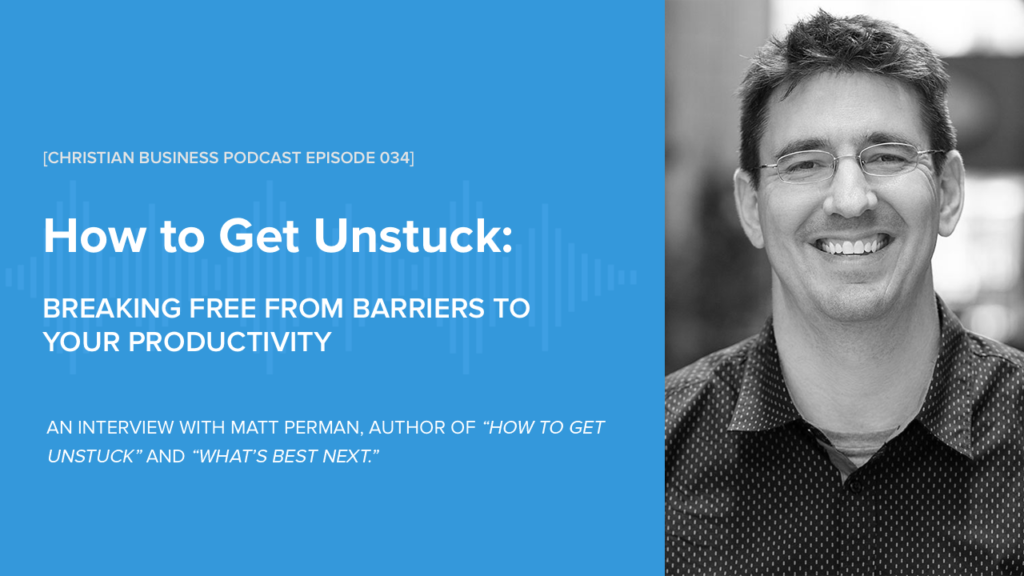
Recently I was on Dawn Sadler’s excellent Christian business podcast Your Purpose is Calling, where we talked about How to Get Unstuck.

Dawn is a writer, speaker and coach who helps people walk in their God-given calling with more clarity and confidence. She is doing great work, and I recommend checking out her podcast and subscribing!


Filed Under: i Productivity Obstacles, Interviews

4 Big Ideas on Work

July 23, 2019 by Matt Perman

One of the best books on the doctrine of work is Leland Ryken’s Redeeming the Time: A Christian Approach to Work and Leisure. I highly recommend it.

Here are four big ideas from his book that go to the heart of the biblical and Reformation understanding of faith and work. If you reflect on these ideas, you begin to see how truly transformative they are.

  1. One of the chief insights of the Reformation is that we can (and must) find God in everyday life, not just in spiritual contemplation and devotion.
  2. We can find God in everyday life because he created it and is Lord of all life.
  3. This means that daily work is not a hinderance to the Christian life, but a necessary ingredient of it. We can find God in our work and work with him in it, as co-workers.
  4. God will judge your work.

Filed Under: 8 - Christian Living, History, Work

Productivity with Your Resume

July 18, 2019 by Matt Perman

One crucial aspect of productivity is getting into the context where you can be the most productive—which means getting the right job. When it comes to the job hunt, resumes are still an essential tool.

So here are six resume dos and don’ts from Brian Brenberg, chair of the program in business and finance at The King’s College. The six tips are:

  1. Don’t fudge the facts
  2. Do include jobs you think nobody cares about
  3. Don’t make spelling and grammar mistakes
  4. Do invite people to critique your work
  5. Don’t assume a good resume will get you a job
  6. Do know your resume inside and out
You can also watch him discuss the points in this video segment. Brenberg is always entertaining and insightful—the best possible combination!

Filed Under: Job Finding

Productivity and Career Development: Updates on What’s Best Next

July 3, 2019 by Matt Perman

If you haven’t seen it on social media, I have an update: Last year I started as director of career development at The King’s College in New York City. In my role I help students launch meaningful careers that will impact the culture through remarkable excellence, professionalism, and service.

I am thrilled to be at King’s and it is a great place. One reason it is such a good fit is that I believe that Christians are called to influence culture, and that is exactly the mission of King’s:

Through its commitment to the truths of Christianity and a biblical worldview, The King’s College seeks to transform society by preparing students for careers in which they help to shape and eventually to lead strategic public and private institutions, and by supporting faculty members as they directly engage culture through writing and speaking publicly on critical issues.

King’s has a fantastic philosophy of education that focuses on seeing the connections across disciplines, and is one of the best Christian colleges in the nation. The opportunity to obtain a rigorous Christian education in the heart of NYC is something that you cannot find anywhere else, and I believe that through this King’s is making a crucial contribution to the call of the gospel to engage the culture winsomely. You can learn more about my role here.

What does this mean for WBN? We are expanding! As we mentioned the other day, Daniel Kaufman, who has many years experience doing training for Chick-fil-A, just joined our team as our newest coach. I highly recommend reaching out to set up a series of coaching sessions with him. I am also available for our 2-Hour DARE coaching package.

My plan is to resume posting regularly and continue creating new products. We have a new book coming in the months ahead, which we will be sharing more about soon. And in December a new study guide and video curriculum for What’s Best Next launches from Zondervan.

In sum, Lord willing, great things are ahead!

Filed Under: WBN News

Get to Know Our Newest Coach

June 26, 2019 by whatsbestnext

At What’s Best Next, we pick our coaches carefully. We can’t just be thinking about productivity in the abstract, we need to know how to understand someone else’s challenges and help them make meaningful change.

That’s why we’re excited to introduce you to our newest coach, Daniel Kaufman. Daniel hails from the southern U.S., where he spent over a decade at Chick-fil-A helping train restaurant leaders and operators. He brings to our team a passion for organizational health, building successful teams, and gospel-driven change. 

Here’s a brief interview we did with Daniel.

Please tell us a little about where you’re from.
I’m a Georgia native, born and raised, and I’ve lived in the same 45-mile radius my whole life. I graduated from a two-stoplight town to another two-stoplight town called Senoia, GA. I grew up in a Christian home, but didn’t become a Christian until my early 20s—a common Bible-belt story. I have 3 siblings and some nieces and nephews that I adore.

What do you like to do for fun?
When I have spare time, I like to practice humility by playing disc golf at one of the local courses. I don’t always make it through all 18 holes, but that’s fine because I stop trying to keep track of my poor score around hole 12. If you walked into my house, you’d notice some musical instruments as well as board games. Both are go-tos when I or my roommates have the time.

How did you begin working with What’s Best Next?
Well, it started with me growing in my walk with the Lord from reading the book What’s Best Next. I had been interested in reading productivity and consulting books through the lens of Scripture. I would write notes in the margins about how something did or didn’t align with the Bible. Matt’s book was the first one I read where the author had already done that work, and I really fell in love with the truths and principles he was teaching. 

Jump forward a few years—I was using What’s Best Next and The Advantage (I’m also a huge Patrick Lencioni fan) to build my teams, but I hit a slump. Somewhere along the way, I learned that What’s Best Next provided productivity coaching. I signed up and started working with Matt. Those times were a huge encouragement to me, but an unexpected side effect was how much I developed a desire to work more with What’s Best Next one day and help others in the way I was helped. What’s Best Next was starting to expand coaching, but the time wasn’t quite right. That was a few years ago. This spring, the timing worked out and I’ve now been coaching officially with What’s Best Next for a few months.

You’ve done a lot of reading about work strategy and tactics. Any favorite tactics or tools you’ve found over the years?
I really like a lot of Patrick Lencioni’s models and checklists. They have helped me significantly. I’m a fan of What’s Best Next’s DARE framework and asking myself the question, “what’s best next?” in a prayerful way. I also use the 5 Whys technique for help in cause and effect problem-solving. A final favorite is the idea that simpler is generally better. We talk a lot at What’s Best Next about sticking to our core mission and centering our work around the right principles. I suppose you could say a favorite “tactic” is pruning to keep things from becoming too complicated.

What’s one of the toughest productivity challenges you’ve faced?
There was a point in my career where my team and I all felt stuck and I was exhausted. We were doing too much and it wasn’t super clear how to make changes within the current system. But we pushed forward and experimented and kept working. I was able to grow in more effective delegation and allowing others on the team to step up and grow. Eventually we got unstuck and after two years we even saw some of the changes we made in our team implemented across the organization, but at the time it felt like we would never make progress.

Do you have a favorite part of working as a What’s Best Next coach?
I’ve really enjoyed the role so far. The team is great to work with, and each person we serve has a unique story that we get to enter into. It’s a privilege to come alongside fellow Christians to support them. Growing up, I always wanted to be involved in so many different things around the world, and coaching has afforded me that opportunity as I work with people from Texas to Thailand.

Curveball. Do you have any hidden talents?
I don’t know about hidden, but I enjoy playing music every so often. Most people have never seen me play much guitar or piano. I studied theory early on, and can somewhat pick up and play any stringed instrument at this point—as long as it doesn’t require a bow!

Any parting advice if someone reading this is thinking about coaching others?
Pray for a genuine interest in the lives and good of others. Stay curious. People are fascinating, and there are always more layers and new insights to be learned for serving them better. You may know someone for years and then something comes up that helps you understand them in a fresh way. So stay curious!


Want to work with Daniel or another What’s Best Next coaches on the productivity challenges you’re facing?
Learn more about our coaching options.


Filed Under: WBN Coaching

More Coaching Spots Now Available

June 20, 2019 by whatsbestnext

We’ve been planning ways to serve you better, and to grow sustainably at What’s Best Next. Lately we’ve focused a lot of energy on expanding our coaching center to help more men and women across industries.

Today we’re happy to announce we’ve increased our coaching capacity.

We now have more summer slots available for our 2 HOUR DARE sessions. Named after the Define, Architect, Reduce, Execute framework in What’s Best Next, these sessions can be a great entry level experience if you’ve never worked with us before—a focused chance to look at some WBN principles and frameworks with an experienced coach to then apply on your own. Or maybe you just need some immediate help tackling current work challenges or are stuck on a complex project.

If you’ve ever thought about What’s Best Next coaching, now’s a great time to jump in on a 2 HOUR DARE session. Spots are first come, first serve for each of our coaches. We look forward to serving each of you soon.

To learn more or request more information about our other coaching options, reach out!

Filed Under: WBN Coaching

Updated Application Journal

April 10, 2019 by whatsbestnext

We’ve been working behind the scenes to change a few things to serve you better. Here’s one of the resources we’re bringing back into our toolkit—the Best Next Steps Application Journal.

This PDF download is a simple tool designed to help someone get back to focusing on what’s best next in their life and work. It offers a taste of how the principles of God’s Word can help us address our motives and actions, and gives a simple way to organize thoughts and next steps.

Download for free from our online store.


Filed Under: Productivity Tools, WBN Product News

  • « Previous Page
  • 1
  • 2

About

What’s Best Next exists to help you achieve greater impact with your time and energy — and in a gospel-centered way.

We help you do work that changes the world. We believe this is possible when you reflect the gospel in your work. So here you’ll find resources and training to help you lead, create, and get things done. To do work that matters, and do it better — for the glory of God and flourishing of society.

We call it gospel-driven productivity, and it’s the path to finding the deepest possible meaning in your work and the path to greatest effectiveness.

Learn More

About Matt Perman

Matt Perman started What’s Best Next in 2008 as a blog on God-centered productivity. It has now become an organization dedicated to helping you do work that matters.

Matt is the author of What’s Best Next: How the Gospel Transforms the Way You Get Things Done and a frequent speaker on leadership and productivity from a gospel-driven perspective. He has led the website teams at Desiring God and Made to Flourish, and is now director of career development at The King’s College NYC. He lives in Manhattan.

Learn more about Matt

Newsletter

Subscribe for exclusive updates, productivity tips, and free resources right in your inbox.

The Book


Get What’s Best Next
Browse the Free Toolkit
See the Reviews and Interviews

The Video Study and Online Course


Get the video study as a DVD from Amazon or take the online course through Zondervan.

The Study Guide


Get the Study Guide.

Other Books

Webinars

Follow

Follow What's Best next on Twitter or Facebook
Follow Matt on Twitter or Facebook

Foundational Posts

3 Questions on Productivity
How to Get Your Email Inbox to Zero Every Day
Productivity is Really About Good Works
Management in Light of the Supremacy of God
The Resolutions of Jonathan Edwards in Categories
Business: A Sequel to the Parable of the Good Samaritan
How Do You Love Your Neighbor at Work?

Recent Posts

  • How to Learn Anything…Fast
  • Job Searching During the Coronavirus Economy
  • Ministry Roundtable Discussion on the Pandemic with Challies, Heerema, Cosper, Thacker, and Schumacher
  • Is Calling Some Jobs Essential a Helpful Way of Speaking?
  • An Interview on Coronavirus and Productivity

Sponsors

Useful Group

Posts by Date

Posts by Topic

Search Whatsbestnext.com

Copyright © 2026 - What's Best Next. All Rights Reserved. Contact Us.