What's Best Next

  • Newsletter
  • Our Mission
  • Contact
  • Resources
    • Productivity
    • Leadership
    • Management
    • Web Strategy
    • Book Extras
  • Consulting & Training
  • Store
    • Online Store
    • Cart
    • My Account
  • About
    • Our Mission
    • Our Core Values
    • Our Approach to Productivity
    • Our Team
    • Contact
You are here: Home / Archives for 1 - Productivity

Resources on Productivity

Understanding Productivity in a New Way: What's Best Next is Now Available! (And Why I Wrote It)

March 4, 2014 by Matt Perman

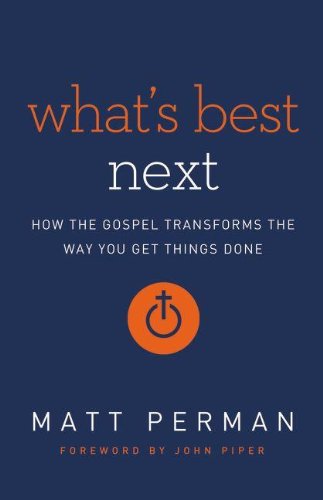
What's Best Next: How the Gospel Transforms the Way You Get Things Done

Finally, after two years of writing and many months of preparing for launch, my book What’s Best Next: How the Gospel Transforms the Way You Get Things Done has been released and is now availabe.

It has been a long road!

Why We Need This Book (and Why I Wrote It)

I wrote the book because I believe that this is what the church most needs to hear most of all right now, at this point in time. And this is slightly ironic, because this is a very practical book and a practical subject, yet I am more of a theologian by nature. In college I spent most days reading theology, writing articles to remember what I wrote, debating atheists and Jehovah’s Witnesses for fun, and talking about these things with my friends. After college, I studied under John Piper (who wrote the foreword) and got my M.Div. at Southern Seminary. You would have thought my first book would be on theology.

But there are lots of books on theology now (and, to be sure, we need more!). There has been an explosion of them in the last ten years (which, again, is a really fantastic thing). What we are lacking now are solid books on the very practical realities we are all dealing with in this new, ultra-connected world of work (and life!) that has emerged over the last twenty years — and that at the same time address these realities on a solid biblical, theological foundation.

And we absolutely need to address these realities, because productivity, managing ourselves, and getting things done are things we all deal with every day. Further, the Scriptures call us to think about all of life in relation to the gospel. Hence, it is critical that we think about productivity and how to get things done in a God-centered, gospel-driven way.

Yet, there are almost no books out there right now that seek to do that.

There are lots of secular books on productivity which are incredibly helpful (I am indebted to David Allen’s Getting Things Done, obviously, and  many more). But none of these books show how our productivity and the things we do every day connect to God and the gospel. On the other hand, over on the biblical side of things, there are very few books (almost none) that give serious reflection to productivity from a biblical perspective while also providing best-in class productivity practices and tips, of the same caliber of books like Getting Things Done or Stephen Covey’s very helpful First Things First. 

So that’s what my book seeks to do.

More specifically, I seek to do two things.

The First Aim of the Book: Present a Biblical Vision of Our Productivity and the Things We Do Every Day in a Unique, Compelling Way

First, I seek to give a biblical vision for how we are to think about our work, productivity, and the things we do every day. The lack of teaching in the church on how our faith relates to our work is one of the reasons that so many struggle with meaning in their work. I seek to show how amazing and surprising the biblical vision for our work and productivity really is (and how relevant it is). Some of the most interesting and significant things we see here are:

A (More Biblical!) Way of Understanding Good Works

We see that good works are not just rare and special things we do, like going to Africa, or spiritual things like leading a Bible study, but anything we do in faith—even tying our shoes. Hence, our vocations are actually one of the chief arenas in which we can serve and worship God. This gives great meaning to the things we do every day (the greatest possible!).

Why it is Absolutely Essential, and not Optional, to Consider Productivity in Relation to God

Lots of books on productivity talk about organizing our lives around “what matters most.” But God is what matters most! Yet none of those secular books — as important as they are — make that point.

We can’t just assume this, or leave “what matters most” up to whatever we say it is. If God exists, then he is the most important reality in the universe, and therefore to truly care about “what matters most” means to care about and love God — and thus center our lives around him.

Therefore, any ultimately “productive” approach to life will have God at the center. Those who seek to be productive without God can do many great and wonderful things, which are to be commended; but we can only be eternally productive if we do everything we do in Christ and for the glory of God (John 15:5). This book fleshes that out, and shows why it is good news.

Why This Matters for Non-Christians as Well as Christians

This book is also written for those who are not Christians, though I recognize many might not be initially inclined to pick up a God-centered book on productivity.

I tried to write in such a way as to show why it is reasonable to consider the claims of Christ for anyone who cares about productivity. For if we care about being productive, shouldn’t we care about what is ultimately productive forever — namely, living our lives for Christ? It’s worth considering. That’s what I want to say (and show) to those who are not already approaching this from a God-centered point of view. And so, for example, I seek to show how Stephen Covey’s principle-centered approach to productivity (the best yet) naturally leads to something beyond that — namely, a God-centered approach.

While I hope that any non-Christians who read this book will give serious consideration to the claims of Christ, there is also much they will benefit from even if they do not take that path. I believe that, as Christians, we are to serve all people (Galatians 6:10; 1 Thessalonians 3:12), and this book will be useful even to those who do not share my faith.

The Second Aim of the Book: Present a Practical Approach for Getting The Most Important Things Done that Actually Works

Then, after giving a biblical perspective for how we are to understand our productivity and work in a new way because of the gospel, I seek to provide a practical approach for improving our productivity in every area of life.

I seek to provide an approach that is simple, yet deals with all levels of our work and lives. Those who love GTD like I do will recognize GTD as a significant part of the framework (and I give many shout-outs to it), but this book is not a re-hash of GTD. I seek to develop it further, and also simplify it in many respects.

I seek to give an approach you can follow even if you aren’t in to having very many lists (though I do believe lists are very helpful and often necessary). Further, my approach is top-down (whereas GTD is bottom-up). I also integrate some of the best insights from books like Scott Belsky’s Making Ideas Happen, Peter Drucker’s The Effective Executive, and many others.

Some of the things you will learn in these sections include:

Mission Statements (that work! and aren’t stuck in the 80s…)

Mission statements matter! But many don’t work well for people, because we do it wrong. So we look at how to create a mission statement for your life that actually works (and why this matters).

Identifying Your Life Calling

It is also important to know how to identify your chief calling in life — the one thing you are most fully on the planet to do (note: this is actually something different from your mission statement), and do it in a God-centered way. This can be especially helpful when having to make career decisions and other major life decisions.

Creating a Flexible Framework (Time Map) for Your Week

Even when you know your chief priorities, they don’t happen automatically because systems trump intentions. Hence, you need to weave them into the fabric of your life through a flexible framework so they actually get done.

This is most of all done through creating a flexible time map for your week. In these chapters, we also get some glimpses into how the president schedules his day (I interviewed one of president Bush’s former schedulers in preparation for this book) and how Christian leaders like Al Mohler get things done.

Delegating–in God-Centered Way
We look at how to delegate in a way that actually works and empowers people, rather than treating them like machines or gophers.

If we are to be God-centered in everything, that includes delegation! There is a way to be God-centered in our delegation that we often overlook, and is fundamental to what it means to treat people with respect and dignity (which are fundamental to any God-centered approach to life — if we are to honor God, then we must honor people, who are made in his image; this is non-negotiable, and has to be reflected in the way we go about our work). God-centerd delegation means delegating to people in a way that truly empowers them and hands over real responsibility. It is based on trust. We look at what this means, and how to do it well.

Processing Workflow, Managing Projects, and the Details of Execution
And, of course, we look at how to get things done in the moment by learning how to process workflow and get your email inbox to zero every day, how to manage projects and keep track of all your actions and information through simple project plans, how to plan your week, and the six routines you need to have in your week.

The Last Section: The Results of Gospel-Driven Productivity

Then, in the final section, I show how all of this connects to God’s global purposes, including productivity in our organizations and society, and ultimately world missions. Ultimately, we see that as we are productive in a God-centered way in every area of our lives, God transforms the world through our work socially, economically, and spiritually. (And, perhaps most interestingly, this is precisely what Paul teaches in Ephesians 5:8-17, the core New Testament passage on time management.)

(And Some Other Things)

That’s a quite-extended snapshot of the book, and there are still many, many things I left out! I will be posting on the book throughout the week to give you shorter snapshots and some of the other key take-aways, including the D-A-R-E process that I use to summarize and integrate all of these things in a way that (hopefully) makes it easy to remember.

Some Blog Posts on the Book So Far

Several people have blogged on the book so far, and there are many more posts to come that I am aware of. Here are a few of the key posts so far:

  • Justin Taylor’s post on What’s Best Next
  • Matt Heerema’s post The One Book You Should Read This Year
  • Andy Naselli’s post (with a great summary of the book and the table of contents)
  • Joshua Van Der Merwe’s post Three Reasons You Should Read What’s Best Next by Matt Perman 

Here are also some other resources on the book you might find useful:

  • The page for the book on this site, with all the endorsements, a briefer summary than this post (!), a sample of the book, and more.
  • John Piper’s foreword for the book.

Some Reader Comments

I suppose I should also list some of the endorsements. I’ll post just a few for now, but you can see all of them on the page for the book listed just above.

Perhaps most interesting are some of the comments I’ve received from other advance readers so far. Here are a few:

“This book has such fruit-bearing potential I wish I’d started a blog years ago for the sole purpose of recommending it today. If you struggle to manage the number of things on your plate and want to serve people more effectively with the time that you have, you need to embrace and apply the principles in this book.”

“The table of contents made me want to stay up all night.”

And, here are three of the endorsements:

“This book is simply extraordinary…. I doubt there is a person on the planet who knows both theological issues and time-management literature to the depth and extent Matt Perman does.”

—John Piper, founder and teacher, desiringGod.org; author, Don’t Waste Your Life

“In this amazing volume, Matt Perman offers a wealth of practical, real-world productivity solutions, all framed within the context of the Gospel. He provides the know-how and the know-Who we need to be faithful stewards over the gifts we have been given.”

—Michael Hyatt, New York Times bestselling author of Platform; MichaelHyatt.com

“As Christians, we are called by God to work with all our heart, because our work is—or should be—directly for the Lord. But beyond platitudes no one has really approached being productive at working, until now. Matt Perman approaches the task not only from his personal experience, but from a Christian worldview. Follow his model to align what you do with God’s purpose in your life—and in particular in your work.”

—B. Joseph Pine II, co-author, The Experience Economy

In Sum: Read the Book!

At the end of the day, I think the best way to experience the book is to read it! So I encourage you to pick up a copy, either in hardcover (Zondervan did an amazing job — it is a truly beautiful book) or for an eReader like Kindle.

(And Share It…)

Last of all: consider sharing the book with others by telling them about it, whether through tweeting this post or any of those listed above, tweeting anything else about the book, or through emailing them the Amazon page (here’s the link again: http://bit.ly/whatsbestnext) or through any other means.

There is a growing movement of gospel-centered Christians that are incredibly good at what they do in their jobs, and are excited about seeing all of life in light of the gospel. This book aims to help give a lift to that movement, which truly consists of all Christians who are eager to serve the Lord to the max with all of their gifts, without burning themselves out in the process.

I hope you enjoy the book and find it very helpful.

And, let me know what you think!

Filed Under: 1 - Productivity, WBN the Book

My Interview with Seth Godin on the Essence of Productivity and Avoiding Productivity Whining

March 3, 2014 by Matt Perman

This is the full version of my interview with Seth Godin on the essence of productivity and avoiding productivity whining, found in chapter 10 of my book What’s Best Next.

Filed Under: 1 - Productivity

The Cornerstone of Winston Churchill's Time Management

February 6, 2014 by Matt Perman

It is fascinating that when you study the most effective individuals throughout history, you see the same theme coming back again and again in how each of them managed their time. The key was focus and concentration on a few very significant priorities, always keeping in mind what is centrally important at the moment (that is, what’s best next).

We see this especially in Winston Churchill. Here’s how Steven Hayward very effectively summarizes Churchill’s approach in Churchill on Leadership: Executive Success in the Face of Adversity:

Despite his wide-ranging attention and interests, he always kept in mind what was centrally important to the moment. He was always able to focus his full concentration on the immediate task at hand, and he sent clear signals to his subordinates when an inquiry or directive was of special importance. “When his mind was occupied with any particular problem,” Sir Ian Jacob wrote, “it was relentlessly focused upon it and would not be turned aside.” Ultimately this served as the cornerstone of his time-management system. 

….His general method of work…was to concentrate his personal attention on the two or three things that mattered most at any given moment, and to give to each of these all the time and attention that it merited.

This is the same observation Peter Drucker made about effective executives in the midst of his 50 years of observing them: “Effective executives put first things first, and do one thing at a time.” That’s the key.

Note one misunderstanding we can fall into, however, about what it means to focus on a few core priorities. It doesn’t mean that you are getting less done and doing fewer things overall. Rather, it means you are doing more things overall. That’s why you do one thing at a time — precisely because you have so many things that need to be done. Hence, you focus on one thing at a time because “doing one thing at a time means doing it fast. The more one can concentrate time, effort, and resources, the greater the number and diversity of tasks one can actually perform” (Drucker, The Effective Executive).

So the key is you identify that which is centrally important, and work on that all the way until it’s done. Then you work on the next thing of central importance until it is done. And so forth. (And, of course, above all of these and governing the choices you make about what to do next are just a few, overall, chief goals for the current quarter or year or season.) Drucker summarizes this well:

Effective executives know that they have to get many things done — and done effectively. Therefore, they concentrate — their own time and energy as well as that of their organization — on doing one thing at a time, and on doing first things first.

Filed Under: 1 - Productivity

4 Principles for Setting the Right Priorities

February 5, 2014 by Matt Perman

From Peter Drucker in The Effective Executive:

  • Pick the future against the past;
  • Focus on opportunities rather than on problems;
  • Choose your own direction, rather than climb on the bandwagon; and
  • Aim high, aim for something that will make a difference, rather than for something that is “safe” and easy to do.

Filed Under: Decision Making, Prioritizing

How to be Productive in 2014

January 1, 2014 by Matt Perman

My guest post at The Institute for Faith, Work, and Economics. I talk about the importance of setting goals and how to do it well for this year, without overwhelming yourself.

Filed Under: 1 - Productivity

How to Delegate When You're Overwhelmed

November 26, 2013 by Matt Perman

This is a really good article over at 99U on overcoming the biggest obstacle to delegation. I love out how it starts out by nailing the exact difficulty that I find with delegation:

You’ve tried every productivity hack in the book and have reached your max capacity in terms of output. You know that you need outside help to bring the work to the next level… but you hesitate. On the one hand, the idea of not having to do everything yourself really appeals to you. On the other, you wonder if you can handle the management responsibilities on top of your already heavy workload.

Your concerns are valid. In order for people to help you, they need to know what you need and to receive feedback and direction along the way. Your workflow that was uniquely yours will now have to account for another person. With the right systems and communication, this process can run relatively smoothly. But without them, the people who were supposed to help can end up creating more work.

She then gives five very helpful strategies. It’s worth the read.


Filed Under: Delegation

Seasons of Low Productivity Are Not Always Bad

November 22, 2013 by Matt Perman

I appreciated this post from Michael Hyatt today on how he’s had a low-productivity week. I can relate, because my week was the same! It’s frustrating.

I even did a sort of experiment this week. Normally this week I’m at ETS, the annual convention of the evangelical theological society. I didn’t go this year. So I thought it was a good opportunity to test this question: Do business trips decrease your tangible productivity?

As I’ve argued elsewhere on this blog, I believe that conferences are incredibly productive because of the relationships developed. In fact, I believe that everyone should go to every conference they can.

But the question I was experimenting with this week is: what does business travel do to the more tangible aspects of your productivity? Specifically, would I have a more productive week in terms of tangible output because of not taking that trip this week?

Unfortunately, I feel like I would have gotten just as much done on that front if I had gone to Baltimore this week for ETS as if I had stayed home. For if I had gone to Baltimore, I would have put in a good 12 hour day before leaving in order to get a bunch of stuff moved ahead, and would have had a plan for a bunch of reading and such in between sessions. There would have been also time on the plane for work, and on top of that the conference itself. As it was, I got some good stuff done this week, but not near what I had hoped or planned, and my energy flagged on several days.

It’s probably not always the case that you can get the same amount of tangible things done on a business trip as if don’t go, and there have been many times when I’ve had to skip out on a trip because of tight project deadlines. But I think we can conclude that at least on many occasions, business trips do not cut down on your tangible productivity, but sometimes even increase it.

The question of business trip productivity aside, all of us can relate to Hyatt’s point about having low productivity weeks. What should we think about those?

I actually think low productivity weeks are not always bad. One of the features you’ll see in my book when it comes out (the release is set for March) is that I rarely fall into the stereotypical thinking on productivity. I believe that the process of productivity and effectiveness is much less linear than we often think; there is often a three steps forward, two steps back component.

Which means we can be encouraged even in the midst of times when it doesn’t feel like we are being productive. That’s why in an earlier version of the book, I even had a box called “Seasons of Low Productivity Are Not Always Bad,” quoting Jason Fried from a great post on his blog a few years ago. (I had to cut the box for space reasons from the final version, unfortunately.)

So, for the encouragement of everyone who had a low productivity week this week (inlacing me!), here is that box from the original version of my book:

Seasons of Low Productivity Are Not Always Bad

Jason Fried, co-founder of 37 Signals and author of Rework, from his blog:

“A few weeks ago, I was on fire. I was working on some designs for a prototype of a new software product, and the ideas were flowing as they hadn’t in months. Every day, I felt as if I were accomplishing two or three days’ worth of work. I was in the zone, and it felt fantastic.

“It lasted about three weeks. And then I found myself back at my old pace. Instead of being super productive, I was sort-of productive. Some days, I felt as if I barely accomplished anything.

“So what was wrong? Nothing at all.

“I believe it’s perfectly fine to spend some of your time, maybe even a lot of your time, not firing on all cylinders. Just like full employment isn’t necessarily good for an economy, full capacity isn’t always great for your mind.”

Filed Under: 1 - Productivity

The Virtual Assistant Solution

November 6, 2013 by Matt Perman

The Virtual Assistant Solution: Come up for Air, Offload the Work You Hate, and Focus on What You Do Best is Michael Hyatt’s new e-book, and it looks great.

The concept of a virtual assistant was first brought to the forefront, it seems to me, by Tim Ferriss in his book The Four Hour Workweek. What Tim had limited space to talk about, Michael Hyatt now fleshes out for us in much more detail, going into why a virtual assistant is such a good idea and how to do it well.

Here is the table of contents:

1 Why You Need a Virtual Assistant

2 Why a Virtual Assistant Beats a Traditional One

3 What a Virtual Assistant Can Do for You

4 Answering the Most Common Questions

5 The First 90 Days with Your Virtual Assistant

6 Tools for Staying in Sync

And here’s a helpful overview from the introduction:

The term “virtual assistant” means a lot of things to a lot of different people. To be clear, I’m talking about someone who works remotely and with whom you contract for professional services like clerical work, meeting and event planning, project management and coordination, even marketing and social media. The idea is having help that fits your needs, your schedule, and your budget. And you can have it without the constraints of payroll, benefits, and recruiting.

Authors, coaches, consultants, creatives, doctors, entrepreneurs, executives, nonprofit leaders, lawyers, pastors, professors, and speakers— there’s a long list of people who could benefit from a virtual assistant.

But despite how many people could benefit, I’ve noticed that many are reluctant to take the plunge. As a result, they miss getting the help they need. Maybe that’s you. Maybe you think hiring a full-time, in-office assistant is your only option. Maybe you have no experience with virtual assistance (or have had a bad experience like I did) and don’t think it can work for you.

It can.

This book will clear up the misconceptions and allow you to be more effective with your time and talents. It will equip you to understand the dynamics of a virtual workforce, define how one or more virtual assistants can help you accomplish more than you ever thought possible, and offer practical advice on how to hire, integrate, and fully benefit from your new virtual staff.

(Hyatt, Michael. The Virtual Assistant Solution: Come up for Air, Offload the Work You Hate, and Focus on What You Do Best (Kindle Locations 96-106). Fleming House Publishers. Kindle Edition.)

You can also read more about the book in Michael’s post introducing it.

Filed Under: 1 - Productivity

What's the Difference Between Mission and Vision?

November 4, 2013 by Matt Perman

When reading on leadership, you very quickly come across references to “mission” and “vision.” Unfortunately, the meaning of those terms, and the difference between them, is not often made clear.

So, here’s the difference.

Mission: The ultimate purpose of the organization; it’s reason for existence. It’s why you do what you do. A mission is never “finished,” so a good mission is one that you would still be able to affirm 100 years from now.

Vision: Used in multiple ways. It is sometimes used just to mean a vivid description of what it will look like when you are fulfilling your mission in all the ways you want. More precisely, though, it is typically a large goal, usually 5-10 years out, that represents the chief focus and state of affairs you are seeking to bring about during that time period. Hence, it has a finish point and can be completed — but it is a stretch.   A good vision derives from and is aligned with the mission.

Here’s an example for a church:

Mission: To glorify God as a loving community of Christ-centered people.

Vision: To have a vibrant worshipping community of 1,000 people, from all age groups, who are active in the city for justice and mercy and loving one another, being built up by solid preaching, and meeting in regular fellowship groups.

Note, of course, that if you are a church you don’t need to make numbers central to your vision. I just did that here to help keep the example clear. A good vision is quantifiable in some way; but numerical growth doesn’t need to be central to how you define success for your church. (On the other hand, I don’t think it’s bad to care about numerical growth, either; in fact, I would argue we have a mandate to care about it in some sense, because every person matters.)

Filed Under: b Vision, Personal Vision

There's No Way … Right?

November 3, 2013 by Matt Perman

A great word from Brad Lomenick:

STOP using [“there’s no way”] as an excuse. As believers, as followers of Jesus, if we’re not chasing after something that is so much bigger than we are, and there’s no way we could ever accomplish it without God, then we are playing it too safe.

Is there currently something you are working on, organizing, idea crafting that is so big that everyone around you says “There’s no way!!” If not, it’s time to think big. Get outside your comfort zone. Dream about accomplishing a project so out of your abilities that it keeps you up at night.

God calls us to think big. If we are only working on something that we can accomplish on our own, with our own strength, I’m not sure that’s good enough.

So what’s on your heart or stirring in you that you keep pushing back because it just doesn’t seem possible? Whatever it is, put it on the table. Stretch. Pursue it. “There’s no way” those around you will say. But there is a way. God can accomplish what seems impossible to us. With our sweat. And our work. Through His power.

There IS a way WE can do that……

Filed Under: a Productivity Philosophy

  • « Previous Page
  • 1
  • …
  • 8
  • 9
  • 10
  • 11
  • 12
  • …
  • 52
  • Next Page »

About

What’s Best Next exists to help you achieve greater impact with your time and energy — and in a gospel-centered way.

We help you do work that changes the world. We believe this is possible when you reflect the gospel in your work. So here you’ll find resources and training to help you lead, create, and get things done. To do work that matters, and do it better — for the glory of God and flourishing of society.

We call it gospel-driven productivity, and it’s the path to finding the deepest possible meaning in your work and the path to greatest effectiveness.

Learn More

About Matt Perman

Matt Perman started What’s Best Next in 2008 as a blog on God-centered productivity. It has now become an organization dedicated to helping you do work that matters.

Matt is the author of What’s Best Next: How the Gospel Transforms the Way You Get Things Done and a frequent speaker on leadership and productivity from a gospel-driven perspective. He has led the website teams at Desiring God and Made to Flourish, and is now director of career development at The King’s College NYC. He lives in Manhattan.

Learn more about Matt

Newsletter

Subscribe for exclusive updates, productivity tips, and free resources right in your inbox.

The Book


Get What’s Best Next
Browse the Free Toolkit
See the Reviews and Interviews

The Video Study and Online Course


Get the video study as a DVD from Amazon or take the online course through Zondervan.

The Study Guide


Get the Study Guide.

Other Books

Webinars

Follow

Follow What's Best next on Twitter or Facebook
Follow Matt on Twitter or Facebook

Foundational Posts

3 Questions on Productivity
How to Get Your Email Inbox to Zero Every Day
Productivity is Really About Good Works
Management in Light of the Supremacy of God
The Resolutions of Jonathan Edwards in Categories
Business: A Sequel to the Parable of the Good Samaritan
How Do You Love Your Neighbor at Work?

Recent Posts

  • How to Learn Anything…Fast
  • Job Searching During the Coronavirus Economy
  • Ministry Roundtable Discussion on the Pandemic with Challies, Heerema, Cosper, Thacker, and Schumacher
  • Is Calling Some Jobs Essential a Helpful Way of Speaking?
  • An Interview on Coronavirus and Productivity

Sponsors

Useful Group

Posts by Date

Posts by Topic

Search Whatsbestnext.com

Copyright © 2026 - What's Best Next. All Rights Reserved. Contact Us.