What's Best Next

  • Newsletter
  • Our Mission
  • Contact
  • Resources
    • Productivity
    • Leadership
    • Management
    • Web Strategy
    • Book Extras
  • Consulting & Training
  • Store
    • Online Store
    • Cart
    • My Account
  • About
    • Our Mission
    • Our Core Values
    • Our Approach to Productivity
    • Our Team
    • Contact
You are here: Home / Blog

No "Theys" Allowed

February 8, 2011 by Matt Perman

A good point from Sticky Teams: Keeping Your Leadership Team and Staff on the Same Page:

Leadership-oriented teams don’t succumb to the tyranny of the “theys.”

When I came to North Coast, our board leaned heavily to the representative side of the scale. As a result, whenever we dealt with a controversial issue, we spent a great deal of time discussing an apparently large and influential group of people known as “they.”

No one seemed to know who they were, and those who did seem to know weren’t too keen on identifying them. But boy, did they have clout. It seemed to me that they were the largest power block in the church.

As a result, before making decisions, we spent hours worrying how “they” might respond. And afterward, we second-guessed ourselves whenever someone reported, “I’ve been talking to some people about this, and they have some real concerns.”

To make matters worse, I could never find out who “they” were, or how many of them there were. It was strange. For a group as large and powerful as they appeared to be, they sure valued their anonymity.

Finally, I’d had enough. I told the board that as far as I was concerned, the “theys” no longer existed. I’d happily listen to comments and critiques from people with real names and faces. But nebulous theys who didn’t want their identity known and hypothetical theys we couldn’t identify would no longer have any sway.

The board agreed. So we instituted a “no theys” rule. It immediately pulled the rug out from underneath the biggest group of resisters we had and eventually exposed them to be a tiny minority (and at times, a mere figment of our imagination).

Our “no theys” rule applies not only to the board; it also applies to every staff meeting and to all of my dealings with the congregation. Now whenever someone says that they’ve been talking to some people who have a concern, I always ask, “Who are they?”

If I’m told that they wouldn’t be comfortable having their names mentioned, I respond, “That’s too bad, because I’m not comfortable listening to anonymous sources. Let me know when they’re willing to be identified. I’ll be happy to listen.”
Filed Under: 3 - Leadership

Pastoral Ministry and Strengths-Based Leadership

February 8, 2011 by Matt Perman

Eric McKiddie has a good article on what pastors can do about the aspects of their role where they may be weak (which is all pastors in some areas). He hits a good middle ground between completely avoiding those areas and just gutting through it.

Filed Under: b Church & Ministry, Strengths

What is a Miserable Job?

February 8, 2011 by Matt Perman

Post 2 in the series The Three Signs of a Miserable Job

When we think of a “miserable job,” our tendency is to think of a job that involves tasks we don’t like very much. But that’s not what a miserable job is. Your job can involve activities that you actually enjoy very much — and yet it can be miserable.

That’s why it’s critical that we distinguish between a miserable job and a bad job. They are not the same. Lencioni rightly says:

As with beauty, the definition of a bad job lies in the eye of the beholder. [Note that: there are not necessarily any intrinsically “bad” jobs — it depends on your skills and preferences whether a job is a good or bad fit for you.] Some people consider a job bad because it is physically demanding or exhausting, involving long hours in the hot sun. Others see it as one that doesn’t pay well. Still others call a job bad because it requires a long commute or a great deal of time sitting behind a desk. It really depends on who you are and what you value and enjoy. (p. 217)

A miserable job, on the other hand is

the one you dread going to and can’t wait to leave. It’s the one that saps your energy even when you’re not busy. It’s the one that makes you go home at the end of the day with less enthusiasm and more cynicism than you had when you left in the morning. (p. 217)

A miserable job “has nothing to do with the actual work a job involves.” As a result, “miserable jobs are found everywhere — consulting firms, television stations, banks, schools, churches, software companies, professional football teams.” Further, they are also found at every level — “from the executive suite to the reception desk to the mail room.”

That’s important: Every type of job, at every level of an organization, can be a miserable job.

Hence, “a professional basketball player can be miserable in his job while the janitor cleaning the locker room behind him finds fulfillment in his work. A marketing executive can be miserable making a quarter of a million dollars a year while the waitress who servers her lunch derives meaning and satisfaction from her job.”

This is the intriguing thing about the miserable job. It saps your energy and enthusiasm and sometimes even zest for life. But it’s not because you don’t like the activities. It’s because of something else. Three things, actually. Before getting to those three things, however, we need to first discuss the consequences of a miserable job in the next post.

Posts in This Series

  • The 3 Signs of a Miserable Job: An Introduction
  • What is a Miserable Job?
  • What are the Effects of a Miserable Job?
  • What Makes a Job Miserable?
  • What are the Benefits of Managing for Job Fulfillment?
  • Addressing the First Sign: Anonymity
  • Addressing the Second Sign: Irrelevance
  • Addressing the Third Sign: Immeasurement

Filed Under: Job Design

Keller: Both Spiritual and Secular Jobs are God's Work

February 7, 2011 by Matt Perman

Here is an article giving a brief summary of a message on work that Tim Keller recently gave.

A few highlights (from the summary — so a summary of a summary!):

Pastor Tim Keller challenged a crowd of New York City professionals Sunday to rethink how they view work and to debunk the notion that spiritual vocations matter more to God than secular work.

. . .

The Medieval Church took a “triumphalism” approach to society that attempted to dominate and make all things Christian where as those in the Radical Reformation encouraged “withdrawal” from society, which they believed to be “Satan’s world.”

Both approaches, according to Keller, had a tendency to look down on the work out in the world and only consider work in the church as God’s work.

He explained that Luther’s theology offered a “middle way” and a biblical approach to work, in which there was no dividing Christian work between “spiritual estate” and the “temporal estate.”

“He says, hey, do not say only people inside the church are doing God’s work. Oh no. We are all priests. Therefore, every Christian is doing God’s work,” said Keller, citing Luther’s reference to the passage in 1 Peter 2:9.

Keller said that God could easily give us His gifts without our help but it is through our works that He wishes to involve, train and include us as part of the family. Quoting Luther, he went on to point out that although man’s work is “child’s performance,” they are the “masks of God” by which He works.

“God doesn’t have to do it that way but He is. He’s loving you through other people’s work. He goes as far as to say that the baker and the farmer in work is God in disguise. These are the masks of God. God is loving you and distributing His gifts through work,” said Keller.

. . .

Belief in the Gospel, according to Keller, should impact one’s motivation of work, work ethic and treatment of others around them in work. He urged listeners to continually gather together and through talks and prayer, accumulate wisdom on how God can have a greater impact in their field.

“You are in a very big city, New York. It is an exhausting city. It’s a very hard place to work. It’s a secular city so it’s very hard to bring your values onto the way you work,” said Keller. “Therefore, because of the power of the Gospel, I call you to think like a prophet, serve like a priest, and plan like a king. It means getting together to think, think, how does the preeminence of God reign in my field. It means serving each other and serving people around you in the city.”

Filed Under: Work

The 3 Signs of a Miserable Job: An Introduction

February 7, 2011 by Matt Perman

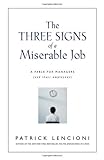
For this week I am going to blog through Patrick Lencioni’s book The Three Signs of a Miserable Job.

I’m doing this for a few reasons.

1. This is one of Lencioni’s best books

This is the first Lencioni book that I ever read and I still regard it as one of his best. Lencioni is one of the best thinkers on leadership, management, and the modern workplace today. His books address core issues of our work in a simple yet very profound way. Reading this particular book led me to enjoy and benefit from all of his other works as well, and I hope many of you can have the same experience.

2. Low job fulfillment is one of the biggest struggles in the modern workforce

As I talk to people all over the country and around the world, it appears to me that lack of job fulfillment is one of the biggest struggles in the modern workforce. This is slightly paradoxical, because it is also true that we are living at a time where more and more people are finding greater fulfillment in their work than ever before. Nonetheless, I think Lencioni captures the issue well when he writes that “more people out there are miserable in their jobs than fulfilled by them” (p. 219). So, in spite of the progress that has been made, there is still a lot of work to do.

3. There is a substantial organizational and human cost to low job fulfillment

Low job fulfillment takes a significant toll on both organizations and people. The organizational cost is decreased productivity and effectiveness. But even more significant than this economic toll, I would argue, is the sheer human cost that lack of job fulfillment exacts. Miserable jobs generate a real form of suffering which has ripple effects into the rest of one’s life. If we can address the issue of job fulfillment effectively, the benefits to people will also affect spill over — thus having an uplifting effect throughout all aspects of society. More on this later.

4. There are simple remedies

Low job fulfillment, in most cases, has some simple remedies. You don’t have to go through complex management training to solve the problem of low job satisfaction. Neither do you have to implement complex plans and schedules and systems. Instead, there are some very basic, very simple things that employees and managers can do to address this problem. Usually it doesn’t even require switching jobs. (As we can see, any job can be miserable and almost any job can be meaningful — there is a difference between a miserable job and a bad job.)

And this is where Lencioni especially shines. Perhaps more than anyone else today, Lencioni illustrates that simple, common sense wisdom can have a far greater effect in making our jobs and organizations run better than most intricate and complex solutions. I hope that this series can be an illustration of that reality to the case of job fulfillment, and that in the process it can help many come to find greater fulfillment in their work.

One last word on the book: Like Lencioni’s other books, The Three Signs of a Miserable Job consists of two parts. The first part is a management fable that illustrates the concepts through a compelling story. The second part is a description of the concepts, or model. I will just be covering the model, and thus would highly recommend getting a copy of the book so that you can see how the concepts play out in the story.

Posts in This Series

  • The 3 Signs of a Miserable Job: An Introduction
  • What is a Miserable Job?
  • What are the Effects of a Miserable Job?
  • What Makes a Job Miserable?
  • 5 Benefits of Managing for Job Fulfillment
  • Addressing the First Sign: Anonymity
  • Addressing the Second Sign: Irrelevance
  • Addressing the Third Sign: Immeasurement

Filed Under: Job Design

  • « Previous Page
  • 1
  • …
  • 155
  • 156
  • 157
  • 158
  • 159
  • …
  • 309
  • Next Page »

About

What’s Best Next exists to help you achieve greater impact with your time and energy — and in a gospel-centered way.

We help you do work that changes the world. We believe this is possible when you reflect the gospel in your work. So here you’ll find resources and training to help you lead, create, and get things done. To do work that matters, and do it better — for the glory of God and flourishing of society.

We call it gospel-driven productivity, and it’s the path to finding the deepest possible meaning in your work and the path to greatest effectiveness.

Learn More

About Matt Perman

Matt Perman started What’s Best Next in 2008 as a blog on God-centered productivity. It has now become an organization dedicated to helping you do work that matters.

Matt is the author of What’s Best Next: How the Gospel Transforms the Way You Get Things Done and a frequent speaker on leadership and productivity from a gospel-driven perspective. He has led the website teams at Desiring God and Made to Flourish, and is now director of career development at The King’s College NYC. He lives in Manhattan.

Learn more about Matt

Newsletter

Subscribe for exclusive updates, productivity tips, and free resources right in your inbox.

The Book


Get What’s Best Next
Browse the Free Toolkit
See the Reviews and Interviews

The Video Study and Online Course


Get the video study as a DVD from Amazon or take the online course through Zondervan.

The Study Guide


Get the Study Guide.

Other Books

Webinars

Follow

Follow What's Best next on Twitter or Facebook
Follow Matt on Twitter or Facebook

Foundational Posts

3 Questions on Productivity
How to Get Your Email Inbox to Zero Every Day
Productivity is Really About Good Works
Management in Light of the Supremacy of God
The Resolutions of Jonathan Edwards in Categories
Business: A Sequel to the Parable of the Good Samaritan
How Do You Love Your Neighbor at Work?

Recent Posts

  • How to Learn Anything…Fast
  • Job Searching During the Coronavirus Economy
  • Ministry Roundtable Discussion on the Pandemic with Challies, Heerema, Cosper, Thacker, and Schumacher
  • Is Calling Some Jobs Essential a Helpful Way of Speaking?
  • An Interview on Coronavirus and Productivity

Sponsors

Useful Group

Posts by Date

Posts by Topic

Search Whatsbestnext.com

Copyright © 2026 - What's Best Next. All Rights Reserved. Contact Us.